NI Hardware Catalog
NI hardware offers I/O and components to create high-quality custom systems. Products include application- and measurement-specific modules, protocol support, FPGA-enabled hardware, and options for industrial and rugged locations.
You can choose from the following popular product categories, or you can use the filters above to browse by platform, function, or system component.
NI voltage products provide voltage measurement and signal generation for control and electrical signaling applications. They support a wide range of voltage levels and include options for industrial and hazardous environments. When integrated into a PXI modular platform, they enable scalable, automated test systems with precise timing and synchronization.
NI digital I/O products can acquire and generate digital signals and patterns at multiple logic levels, including TTL, CMOS, and 24 V. They enable circuit characterization, device control, and flexible automation. Used in test, measurement, industrial control, and prototyping, NI DIO integrates with NI software for configuration, automation, and advanced data analysis.
Sound and vibration products interface with microphones and accelerometers to acquire acoustic and vibration signals. Use these products for audio test; machine condition monitoring; and noise, vibration, and harshness (NVH) applications.
NI temperature measurement products measure signals from sensors such as thermocouples, resistance temperature detectors (RTDs), and thermistors. They acquire, condition, and digitize temperature signals for thermal validation, environmental testing, and industrial process control.
NI strain, pressure, and force products work with bridge-based sensors such as strain gages, and load cells to capture precise mechanical responses. These devices provide excitation, signal conditioning, high-accuracy acquisition for applications like structural testing, durability studies, and materials analysis.
NI oscilloscopes and digitizers are precision modular instruments for capturing and analyzing electrical signals in automated test and high-channel-count systems. Oscilloscopes provide interactive, real-time visualization and measurement, ideal for debugging and design validation, while digitizers deliver high-speed, deep-memory data acquisition for advanced analysis and long-duration recording through software control with fully user-programmable FPGA.
DMMs perform high-precision voltage, current, resistance, temperature, inductance, capacitance, frequency/period measurements, and diode tests. Some advanced DMMs have an isolated digitizer mode that allows users to capture and analyze waveforms. Digital multimeters are used across a wide range of applications from validation to production.
Switches are hardware components used to route electrical signals between instruments and devices under test (DUTs). PXI switches are essential for automating connections, expanding measurement coverage, and increasing throughput without manual rewiring; they are critical for efficient, scalable automated test systems.
Source Measure Units (SMUs) combine high-precision source and measure capability with features designed to reduce test time and increase flexibility. These features include high channel density for building parallel SMU test systems, deterministic hardware sequencing for minimizing software overhead, and high-speed update and sample rates for quickly changing setpoints and acquiring data.
LCR meters can measure the inductance, capacitance, and resistance (LCR) of electronic equipment. LCR meters can help you you repeatedly perform DC and impedance measurements.
Software defined radios are RF transceivers that enable rapid prototyping and deployment of advanced wireless applications. SDRs are used for wireless communications, deploying signals intelligence systems, or as building blocks for multichannel test beds.
Vector Signal Transceivers combine a vector signal generator, vector signal analyzer, and user-programmable FPGA into one device. Use these products for RF and wireless applications such as cellular device testing and RFIC characterization.
Cables connect test and measurement devices to other NI and third-party hardware accessories or to individual header pins. They range from multipurpose coaxial cables to device-specific cables, all with industry-standard connector types to fit your system.
GPIB devices offer dependable connectivity for automating instrument control in test and measurement systems. Supporting the IEEE 488 standard, they enable fast, reliable communication between PCs and instruments, simplifying integration and improving efficiency in automated testing.
Serial interface hardware connects embedded systems and electronic devices. Supporting RS232, RS485, and RS422 serial standards, NI hardware enables efficient data transmission, device control, and integration for automated test and measurement applications.
NI hardware comes in a variety of form factors optimized for the various types of test and measurement applications. If you’re new to NI hardware, consider learning more about these platforms first.
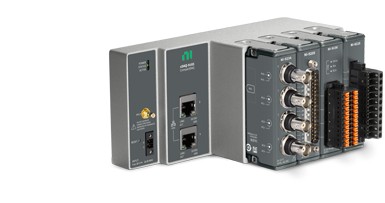
CompactDAQ systems collect and deliver the data validation you need to meet test requirements at any distance, in any environment. These portable, customizable solutions—made of data acquisition modules that can synchronize measurements across a network—help you digitize data closer to sensors, minimizing noise and simplifying cabling in the field.
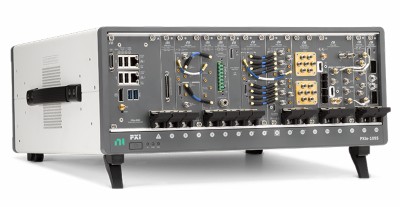
PXI is an advanced test and measurement platform built for automation that combines hardware and software components to tackle complex device testing efficiently, so that engineers can take their first measurement in seconds and transition to automation within the same system. Renowned for its flexibility and reliability, engineers use this platform to build high-performance, mixed-measurement systems for validation and production test.
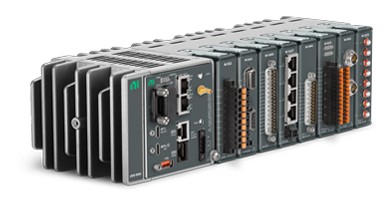
CompactRIO systems provide high-performance processing capabilities, sensor-specific conditioned I/O, and a closely integrated software toolchain that make them ideal for Industrial Internet of Things, monitoring, and control applications. The real-time processor offers reliable, predictable behavior, while the FPGA excels at smaller tasks that require high-speed logic and precise timing.