Propagation Delay Calibration
- Updated2024-06-07
- 4 minute(s) read
Propagation Delay Calibration
The NI Sound and Vibration Measurement Suite provides tools for calibrating the propagation delay of a measurement system.
National Instruments dynamic signal acquisition (DSA) devices like the PXI-4461 can acquire and generate signals on the same device.
You can determine the propagation delay of a DSA device in two ways. You can refer to the documentation for the DSA device to find the propagation delay specifications, also referred to as group delay. You also can measure the propagation delay in samples by using the Sound and Vibration Measurement Suite. You can measure the delay introduced in the input and output circuitry for a specific device at the desired sampling rate. Connect the DSA device output channel directly to the input channel, as displayed in the following illustration, to measure the device propagation delay.

For Multifunction I/O devices from NI, you expect to measure a one-sample propagation delay because of the time required for the signal to traverse the signal path between the D/A converter (DAC) on the analog output channel and the A/D converter (ADC) on the analog input channel. The following illustration shows the time domain data for the propagation delay measurement of an NI PCI-6052E.

For DSA devices, or for any other device that has onboard filtering on either the input, output, or both channels, you expect to measure a propagation delay consistent with the sum of the delays specified for the onboard filters on the input and output channels. The following illustration shows the delay of a smooth pulse generated and acquired by an NI PXI-4461 with a 204.8 kHz sampling rate.
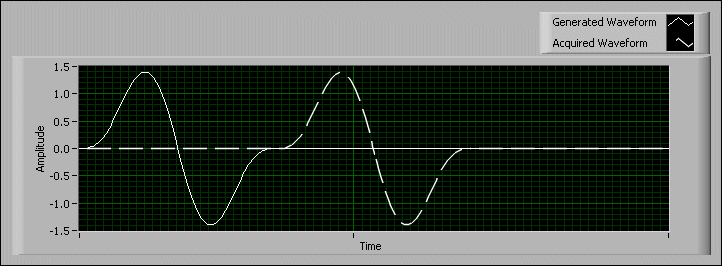
Not all DSA devices have a constant propagation delay across the entire range of supported sampling rates. For example, the NI PXI-4461 propagation delay is dependent on the output update rate. The following figure shows the total propagation delay versus sampling rate relationship for the NI PXI-4461 from output to input as a function of the sampling rate.

In the previous front panels, the propagation delay can vary significantly with different sampling rates and devices. To ensure measurement accuracy in the I/O applications, determine and account for the propagation delay of the DAQ device at the same sampling rate used in the application.
You must remove the effects of the delay that the data acquisition system causes for two reasons. First, a delay between the generated output signal and the acquired input on the device always exists, even when the output and input channels are hardware synchronized. Second, the anti-imaging and anti-aliasing filters of the device introduce additional delays. You must account for this delay to perform accurate dynamic measurements.
The anti-imaging and anti-aliasing filters have a lowpass filter effect on the data. This effect results in a transient response at sharp transitions in the data. These transitions are common at the start and stop of a generation, at a change in frequency (swept sine), and when the amplitude changes (amplitude sweep). The swept-sine analysis and audio measurements examples in the Sound and Vibration Measurement Suite account for this transient behavior in the device response to achieve the highest degree of accuracy.
The propagation delay of the DUT is also an important specification in some applications. For example, the propagation delay for the DUT is a required input when performing audio measurements and when measuring the frequency response using swept sine. If the DUT and the propagation medium can successfully pass the pulse signal without excessive attenuation, then this measurement also applies when measuring the propagation delay of the DUT and the propagation medium. The following illustration shows the wiring diagram for this configuration.
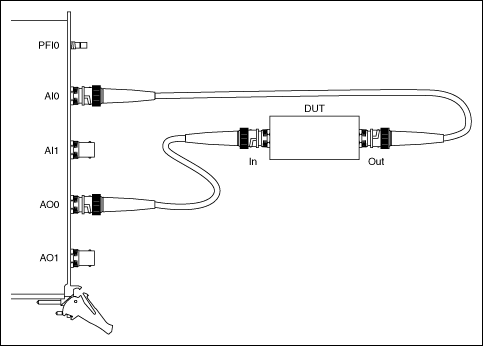
The DUT propagation delay is the delay of the entire system minus the device delay. You must measure the device delay without the DUT connected.
The propagation delay for an analog DUT is a constant time delay rather than a delay of samples. Use the following equation to convert the measured delay in samples to the equivalent delay in seconds:
delay [s] = delay [samples] / sampling rate [Hz]
Related Information
- Anti-Aliasing
Anti-aliasing protects frequency measurements from distortion ensuring accurate data representation.
- Sampling Rate
The scan rate, or the sampling rate in NI-DAQmx, determines how often an analog-to-digital (A/D) conversion takes place.
- Delay Measurements
The propagation delay is the interval between when a sample is generated on the output of your measurement device and when the corresponding sample is acquired on the input side. Quantifying the signal propagation delay is important in many applications involving stimulus and response testing.