Bringing Intelligence Closer to the Data
BUSINESS INSIGHT
SEMICONDUCTOR | 4 MINUTE READ
NI and NVIDIA are bringing AI closer to measurement data, combining instrumentation and GPU computing for real-time processing and faster insights.
How NI and NVIDIA are shortening the distance between measurement and insight
For decades, the standard playbook in test and measurement was straightforward: collect the data, store it, analyze it later. That separation made sense when data volumes were manageable and decisions weren’t time-sensitive.
That world is changing quickly.
Across industries from defense and wireless research to industrial automation, engineers are working with systems that generate far more data than traditional architectures can handle in real time. The gap between when data is acquired and when insight is available has become a technical bottleneck—one that slows down both product development and scientific discovery.
The Problem with Waiting
Traditional test workflows depend on a chain: sensor to storage, storage to processor, processor to human. Each handoff introduces delay. For applications where conditions change in milliseconds, that delay isn’t just inconvenient: It changes the result.
The demand for real-time decision-making is colliding with instruments that can capture significantly more signal bandwidth than before. Processing that data quickly enough to matter requires a different approach to compute.
Pairing Instrumentation with GPU Compute
NI and NVIDIA are building toward tighter integration between measurement hardware and GPU-based processing. The core idea is simple: Rather than sending data off to a separate processor for analysis, bring the compute directly into the data path.
The NI instrumentation platform is designed to stream high-bandwidth data continuously, and NVIDIA GPUs are purpose-built for the parallel processing that real-time signal analysis demands. Together, they enable real-time processing of data as it arrives, whether that means running compute algorithms, machine learning models, or AI inference, instead of waiting until the data has been stored.
A Framework Built for Real-Time AI Streaming
A key part of this collaboration is with NVIDIA Holoscan, an open-source SDK built for high-throughput, low-latency AI applications and DAQIRI, an NVIDIA library for high throughput sensor to GPU data movement. Together, Holoscan and DAQIRI connects instruments, AI, and accelerated computing in one reusable software stack.
Before Holoscan and DAQIRI, running a model against live sensor data meant building custom plumbing for every project: moving data off the instrument, managing transfers into GPU memory, and stitching inference into a pipeline fast enough to keep pace with the stream. Holoscan handles that infrastructure. It simplifies the path from sensor I/O to the GPU and makes it straightforward to deploy an AI model inside a streaming pipeline, using modular components called operators for inference, I/O, and visualization that teams can customize and reuse across applications.
That design is what makes it a natural fit for measurement. Holoscan is domain-agnostic, with C++ and Python APIs built for sensor data processing regardless of where the signal originates. It supports the AI frameworks engineers already use, including TensorRT, ONNX, and PyTorch, so models trained elsewhere can move into a live pipeline without being rewritten. And because it is Apache 2 licensed on GitHub, with sample applications on HoloHub to jump-start new projects, teams start from working reference code rather than a blank page.
NI builds on this foundation with operators that bring measurement hardware directly into Holoscan workflows, handling device configuration and data streaming so developers can focus on the application itself. The result is a development environment where the instrument and the AI model are first-class citizens in the same pipeline.
From Concept to Real-Time Testbed
Using an NI Ettus USRP X410 software defined radio and an NVIDIA DGX Spark, a research team at the University of Texas at Austin built a testbed capable of processing wideband RF signals across up to 1 GHz of bandwidth in real time, classifying signals as they arrive without downsampling or post-processing delays.
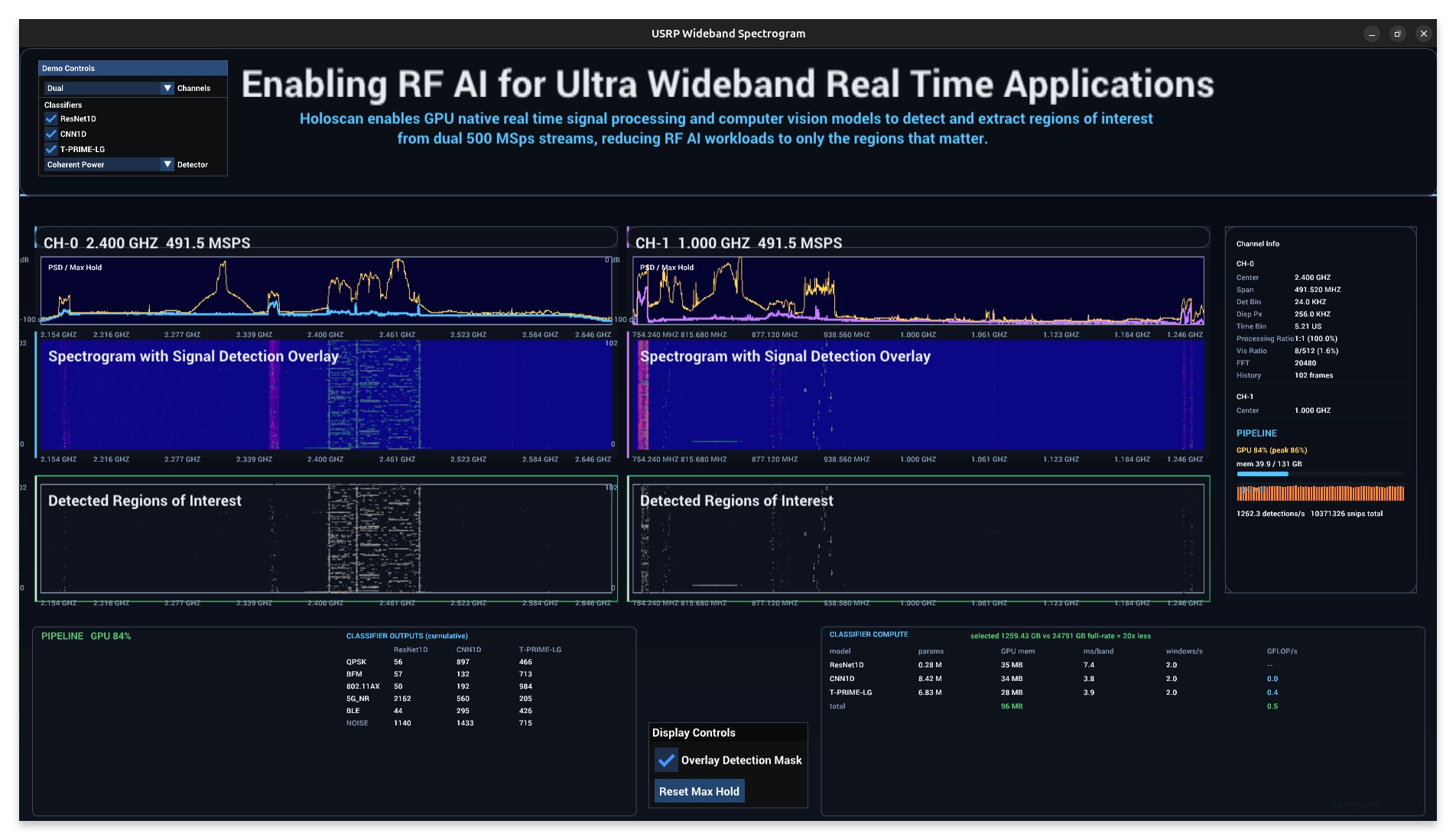
Support for USPR in Holoscan and DAQIRI allows researchers to significantly reduce testbed development timelines.
What This Makes Possible
Tighter integration between measurement and AI compute opens up a class of applications that were previously difficult or cost-prohibitive to build: spectrum-awareness systems that classify signals without human review, adaptive test environments that modify conditions based on live results, and anomaly detection embedded directly in the acquisition layer.
An AI-Native Wireless Testbed
The convergence of high-fidelity instrumentation and GPU-accelerated AI is creating a new blueprint for wireless test and measurement. By pairing NI USRP software-defined radios with NVIDIA accelerated computing, DAQIRI, and Holoscan, developers can build AI-native testbeds that stream high-bandwidth RF data straight into real-time processing pipelines.
Rather than assembling custom infrastructure for every project, teams can start from a reference architecture built to connect measurement, accelerated computing, and AI in a single workflow. The result is a faster path from acquisition to insight, and a real opening for new approaches to wireless research, spectrum awareness, and physical AI development.
A Shared Direction
This is not a future state. Teams are building on it today. What NI and NVIDIA are working toward is making it accessible to any team that needs to close the gap between measurement and action, not just organizations with deep custom engineering resources.
As instruments get faster and AI models get more capable, the question is no longer whether intelligence belongs in the measurement workflow. It's how quickly teams can get there. The tools are ready, the architecture is proven, and the next breakthrough is waiting on whoever decides to start building. The distance between measurement and insight has never been shorter, and the teams that close it first will shape what comes next.