I/Q Modulation
- Updated2026-03-31
- 4 minute(s) read
I/Q is a common way to represent message signals in modern communication systems.
As described in Modulation, there are two fundamental ways (degrees of freedom) to produce a modulated wave from a carrier wave. You can either perturb its amplitude or its phase. I/Q signaling allows you to simultaneously change both amplitude and phase. Modulating a carrier using both degrees of freedom enhances spectral efficiency with regard to bits per hertz of channel bandwidth (for a given bits per second transmission rate) than if using only one degree of freedom.
To simultaneously perturb both the amplitude and phase of a carrier, two canonical forms of frequency-translating transmitters simultaneously use the two degrees of freedom in modulation.
Canonical Polar Modulation
In polar modulation, the message signal is split into two components:
- R(t) controls the changes to the carrier wave amplitude
- φ(t) drives the changes to the carrier wave phase

Canonical Rectangular Modulation
In rectangular modulation, the message signal is also split into two components:
- I(t) controls the changes to the in-phase carrier wave
- Q(t) controls the changes to the quadrature-phase carrier wave

The Mathematical Relationship
The modulated outputs of the two canonical forms are mathematically equal and physically equal. To show their equality, you can compare and translate between the polar and rectangular representations.
Begin with the equation:
Plug in the following trigonometric identity:
to yield the following equation:
When you simplify this equation, you have the following relationship:
where
- I(t) = R(t) cos (φ(t))
- Q(t) = R(t) sin (φ(t))
- ωc = 2πfc
- fc is the carrier frequency in Hertz
The rectangular form of modulation, often called I/Q Modulation, is popular for certain technical reasons.
In the rectangular modulation figure, the real baseband signals of I(t) and Q(t) are created (in some way) to contain all the information of message input m(t). The polar R(t) and φ(t) also contain the information of m(t). Because the carriers cos(ωc(t)) and sin(ωc(t)) are orthogonal functions, NI uses the terminology of quadrature modulation:
where
- The signal applied to the cosine mixer is called the in-phase component (I)
- The signal applied to the sine mixer is called the quadrature-phase component (Q)
The I and Q designations are useful because the I(t) baseband signal is applied to the cosine mixer. The Q(t) baseband signal is applied to the sine mixer.
The analytical relationship between the polar form (R(t) and φ(t)) of the baseband signal and Cartesian form (I(t) and Q(t)) of the baseband signal is shown in the following figure.
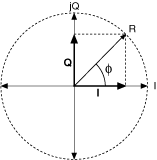
The diagram is a snapshot in time of the complex (analytical) baseband envelope g(t). Because the diagram is for an arbitrary instant in time, the independent time variable t is dropped. The amplitude of Q is projected onto the imaginary (j) axis and the amplitude of I is projected onto the real axis.
I/Q modulation produces a single-sideband suppressed carrier waveform to modulate baseband signals. A lower sideband suppressed carrier can be configured with the following equations:
where
- ωc represents the carrier frequency
- ωb represents the baseband frequency
- t represents time
Related Information
- Modulation
Modulation is a process that alters the characteristics of a carrier wave according to information in the message signal to generate and transmit a modulated wave.