PCI/PXI/USB-6281 Specifications
- Updated2025-11-05
- 16 minute(s) read
PCI/PXI/USB-6281 Specifications
PCI/PXI/USB-6281 Specifications
These specifications apply to the PCI/PXI/USB-6281.
The following specifications are typical at 25 °C, unless otherwise noted.
Revision History
| Version | Date changed | Description |
|---|---|---|
| 375218F-01 | October 2025 | Updated I/O connector specifications. |
| 375218E-01 | June 2025 | Added pinout. |
| 375218D-01 | September 2024 | Updated Compliance content. |
| 375218C-01 | June 2016 | Updated Compliance content. |
| 375218B-01 | September 2015 | Updated legal notifications. |
| 375218A-01 | May 2015 | Initial release (PCI/PXI/USB-6281 only). |
| 371292G-01 | June 2007 | Original specifications document: NI 628x Specifications. |
Looking For Something Else?
For information not found in the specifications for your product, such as operating instructions, browse Related Information.
PCI/PXI/USB-6281 Pinout


Analog Input
| Number of channels | 8 differential or 16 single ended |
| ADC resolution | 18 bits |
| DNL | No missing codes guaranteed |
| INL | Refer to AI Absolute Accuracy |
| Input coupling | DC |
| Input range | ±0.1 V, ±0.2 V, ±0.5 V, ±1 V, ±2 V, ±5 V, ±10 V |
| Maximum working voltage for analog inputs (signal + common mode) | ±11 V of AI GND |
| CMRR (DC to 60 Hz) | 110 dB |
| Input bias current | ±100 pA |
| Small signal bandwidth (-3 dB) | 750 kHz filter off, 40 kHz filter on |
| Input FIFO size | 2,047 samples |
| Scan list memory | 4,095 entries |
| Single channel maximum | 625 kS/s |
| Multichannel maximum (aggregate) | 500 kS/s |
| Minimum | No minimum |
| Timing accuracy | 50 ppm of sample rate |
| Timing resolution | 50 ns |
| Device on, AI+ to AI GND | >10 GΩ in parallel with 100 pF |
| Device on, AI- to AI GND | >10 GΩ in parallel with 100 pF |
| Device off, AI+ to AI GND | 820 Ω |
| Device off, AI- to AI GND | 820 Ω |
| Adjacent channels | -75 dB |
| Non-adjacent channels | -95 dB |
| PCI/PXI | DMA (scatter-gather), interrupts, programmed I/O |
| USB | USB Signal Stream, programmed I/O |
| Device on | ±25 V for up to eight AI pins |
| Device off | ±15 V for up to eight AI pins |
| Input current during overvoltage condition | ±20 mA maximum/AI pin |
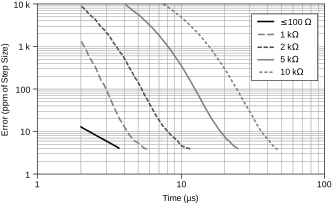
Settling Time for Multichannel Measurements
| Range | Filter Off ±15 ppm of Step (±4 LSB for Full-Scale Step) | Filter Off ±4 ppm of Step (±1 LSB for Full-Scale Step) | Filter On ±4 ppm of Step (±1 LSB for Full-Scale Step) |
|---|---|---|---|
| ±5 V, ±10 V | 2 μs | 8 μs | 50 μs |
| ±0.5 V, ±1 V, ±2 V | 2.5 μs | 8 μs | 50 μs |
| ±0.1 V, ±0.2 V | 3 μs | 8 μs | 50 μs |
Typical Performance Graphs


AI Absolute Accuracy
AI Absolute Accuracy (Filter On)
| Nominal Range Positive Full Scale | Nominal Range Negative Full Scale | Residual Gain Error (ppm of Reading) | Residual Offset Error (ppm of Range) | Offset Tempco (ppm of Range/°C) | Random Noise, σ (μVrms) | Absolute Accuracy at Full Scale (μV) | Sensitivity (μV) |
|---|---|---|---|---|---|---|---|
| 10 | -10 | 40 | 8 | 11 | 60 | 980 | 24 |
| 5 | -5 | 45 | 8 | 11 | 30 | 510 | 12 |
| 2 | -2 | 45 | 8 | 13 | 12 | 210 | 4.8 |
| 1 | -1 | 55 | 15 | 15 | 7 | 120 | 2.8 |
| 0.5 | -0.5 | 55 | 30 | 20 | 4 | 70 | 1.6 |
| 0.2 | -0.2 | 75 | 45 | 35 | 3 | 39 | 1.2 |
| 0.1 | -0.1 | 120 | 60 | 60 | 2 | 28 | 0.8 |
| Gain tempco | 17 ppm/°C |
| Reference tempco | 1 ppm/°C |
| INL error | 10 ppm of range |
AI Absolute Accuracy (Filter Off)
| Nominal Range Positive Full Scale | Nominal Range Negative Full Scale | Residual Gain Error (ppm of Reading) | Residual Offset Error (ppm of Range) | Offset Tempco (ppm of Range/°C) | Random Noise, σ (μVrms) | Absolute Accuracy at Full Scale (μV) | Sensitivity (μV) |
|---|---|---|---|---|---|---|---|
| 10 | -10 | 45 | 10 | 11 | 70 | 1,050 | 28.0 |
| 5 | -5 | 50 | 10 | 11 | 35 | 550 | 14.0 |
| 2 | -2 | 50 | 10 | 13 | 15 | 230 | 6.0 |
| 1 | -1 | 60 | 17 | 15 | 12 | 130 | 4.8 |
| 0.5 | -0.5 | 60 | 32 | 20 | 10 | 80 | 4.0 |
| 0.2 | -0.2 | 80 | 47 | 35 | 9 | 43 | 3.6 |
| 0.1 | -0.1 | 120 | 62 | 60 | 9 | 31 | 3.6 |
| Gain tempco | 17 ppm/°C |
| Reference tempco | 1 ppm/°C |
| INL error | 10 ppm of range |
AI Absolute Accuracy Equation
AbsoluteAccuracy = Reading · (GainError) + Range · (OffsetError) + NoiseUncertainty
- GainError = ResidualAIGainError + GainTempco · (TempChangeFromLastInternalCal) + ReferenceTempco · (TempChangeFromLastExternalCal)
- OffsetError = ResidualAIOffsetError + OffsetTempco · (TempChangeFromLastInternalCal) + INLError
- NoiseUncertainty = for a coverage factor of 3 σ and averaging 100 points.
AI Absolute Accuracy Example
Absolute accuracy at full scale on the analog input channels is determined using the following assumptions:
- TempChangeFromLastExternalCal = 10 °C
- TempChangeFromLastInternalCal = 1 °C
- number_of_readings = 100
- CoverageFactor = 3 σ
For example, on the 10 V range of the Filter On accuracy table, the absolute accuracy at full scale is as follows:
- GainError = 40 ppm + 17 ppm · 1 + 1 ppm · 10 = 67 ppm
- OffsetError = 8 ppm + 11 ppm · 1 + 10 ppm = 29 ppm
- NoiseUncertainty = = 18 µV
- AbsoluteAccuracy = 10 V · (GainError) + 10 V · (OffsetError) + NoiseUncertainty = 980 µV
Analog Triggers
| Number of triggers | 1 |
| Source | AI <0..15>, APFI 0 |
| Functions | Start Trigger, Reference Trigger, Pause Trigger, Sample Clock, Convert Clock, Sample Clock Timebase |
| Resolution | 10 bits, 1 in 1,024 |
| Modes | Analog edge triggering, analog edge triggering with hysteresis, and analog window triggering |
| Accuracy | ±1% of range |
| AI <0..15> | ±Full scale |
| APFI 0 | ±10 V |
| AI <0..15> | 700 kHz filter off, 40 kHz filter on |
| APFI 0 | 5 MHz |
| Input impedance | 10 kΩ |
| Coupling | DC |
| Protection, power on | ±30 V |
| Protection, power off | ±15 V |
Analog Output
| Number of channels | 2 |
| DAC resolution | 16 bits |
| DNL | ±1 LSB |
| Monotonicity | 16 bit guaranteed |
| Accuracy | Refer to AO Absolute Accuracy |
| Output coupling | DC |
| Output impedance | 0.2 Ω |
| Output current drive | ±5 mA |
| Output FIFO size | 8,191 samples shared among channels used |
| 1 channel | 2.86 MS/s |
| 2 channels | 2.00 MS/s per channel |
| Timing accuracy | 50 ppm of sample rate |
| Timing resolution | 50 ns |
| Calibrated ranges | ±1 V, ±2 V, ±5 V, ±10 V |
| Offset sources | 0 V, 5 V, APFI 0 , AO <0,1 >[1]1 An AO channel cannot be a reference or offset to itself. |
| Reference sources | 1 V, 5 V, 2 V, 10 V, APFI 0, AO <0,1>[2]2 When the USB Screw Terminal device is powered on, the analog output signal is not defined until after the USB configuration is complete. |
| Maximum output level | ±11 V |
| Overdrive protection | ±25 V |
| Overdrive current | 20 mA |
| Power-on state[3]3 For all USB Screw Terminal devices, when powered on, the analog output signal is not defined until after USB configuration is complete. | ±5 mV |
| Power-on glitch | 2.3 V peak for 1.2 s |
| PCI/PXI | DMA (scatter-gather), interrupts, programmed I/O |
| USB | USB Signal Stream, programmed I/O |
| AO waveform modes | Non-periodic waveform, periodic waveform regeneration mode from onboard FIFO, periodic waveform regeneration from host buffer including dynamic update |
| Settling time, full-scale step, 15 ppm (1 LSB) | 3 µs |
| Slew rate | 20 V/µs |
| Magnitude | 15 mV |
| Duration | 0.5 µs |
External Reference
| Input impedance | 10 kΩ |
| Coupling | DC |
| Protection, device on | ±30 V |
| Protection, device off | ±15 V |
| Range | ±11 V |

AO Absolute Accuracy
Absolute accuracy at full-scale numbers is valid immediately following internal calibration and assumes the device is operating within 10 °C of the last external calibration.
| Nominal Range Positive Full Scale | Nominal Range Negative Full Scale | Residual Gain Error (ppm of Reading) | Gain Tempco (ppm/°C) | Residual Offset Error (ppm of Range) | Offset Tempco (ppm of Range/°C) | Absolute Accuracy at Full Scale (μV) |
|---|---|---|---|---|---|---|
| 10 | -10 | 55 | 15 | 30 | 12 | 1,540 |
| 5 | -5 | 60 | 15 | 30 | 17 | 820 |
| 2 | -2 | 65 | 25 | 40 | 30 | 404 |
| 1 | -1 | 85 | 25 | 57 | 50 | 259 |
| Reference tempco | 1 ppm/°C |
| INL error | 32 ppm of range |
AO Absolute Accuracy Equation
AbsoluteAccuracy = OutputValue · (GainError) + Range · (OffsetError)
- GainError = ResidualGainError + GainTempco · (TempChangeFromLastInternalCal) + ReferenceTempco · (TempChangeFromLastExternalCal)
- OffsetError = ResidualOffsetError + AOOffsetTempco · (TempChangeFromLastInternalCal) + INLError
Digital I/O/PFI
Static Characteristics
| Number of channels | 24 total, 8 (P0.<0..7>), 16 (PFI <0..7>/P1, PFI <8..15>/P2) |
| I/O type | 5 V TTL/CMOS compatible |
| Ground reference | D GND |
| Direction control | Each terminal individually programmable as input or output |
| Pull-down resistor | 50 kΩ typical, 20 kΩ minimum |
| Input voltage protection | ±20 V on up to two pins[4]4 Stresses beyond those listed under Input voltage protection may cause permanent damage to the device. |
Waveform Characteristics (Port 0 Only)
| Terminals used | Port 0 (P0.<0..7>) |
| Port/sample size | Up to 8 bits |
| Waveform generation (DO) FIFO | 2,047 samples |
| Waveform acquisition (DI) FIFO | 2,047 samples |
| DI or DO Sample Clock source[5]5 The digital subsystem does not have its own dedicated internal timing engine. Therefore, a sample clock must be provided from another subsystem on the device or an external source. | Any PFI, RTSI, AI Sample or Convert Clock, AO Sample Clock, Ctr n Internal Output, and many other signals |
| PCI/PXI | 0 MHz to 10 MHz, system and bus activity dependent |
| USB | 0 MHz to 1 MHz, system and bus activity dependent |
| Regenerate from FIFO | 0 MHz to 10 MHz |
| Streaming from memory | 0 to 10 MHz, system and bus activity dependent |
| Regenerate from FIFO | 0 MHz to 10 MHz |
| Streaming from memory | 0 MHz to 1 MHz, system and bus activity dependent |
| PCI/PXI | DMA (scatter-gather), interrupts, programmed I/O |
| USB | USB Signal Stream, programmed I/O |
PFI/Port 1/Port 2 Functionality
| Functionality | Static digital input, static digital output, timing input, timing output |
| Timing output sources | Many AI, AO, counter, DI, DO timing signals |
| Debounce filter settings | 125 ns, 6.425 µs, 2.56 ms, disable; high and low transitions; selectable per input |
Recommended Operating Conditions
| Level | Minimum | Maximum |
|---|---|---|
| Input high voltage (VIH) | 2.2 V | 5.25 V |
| Input low voltage (VIL) | 0 V | 0.8 V |
| Output high current (IOH) P0.<0..7> | — | -24 mA |
| Output high current (IOH) PFI <0..15>/P1/P2 | — | -16 mA |
| Output low current (IOL) P0.<0..7> | — | 24 mA |
| Output low current (IOL) PFI <0..15>/P1/P2 | — | 16 mA |
Electrical Characteristics
| Level | Minimum | Maximum |
|---|---|---|
| Positive-going threshold (VT+) | — | 2.2 V |
| Negative-going threshold (VT-) | 0.8 V | — |
| Delta VT hysteresis (VT+ - VT-) | 0.2 V | — |
| IIL input low current (Vin = 0 V) | — | -10 µA |
| IIH input high current (Vin = 5 V) | — | 250 µA |
Digital I/O Characteristics


General-Purpose Counters/Timers
| Number of counter/timers | 2 |
| Resolution | 32 bits |
| Counter measurements | Edge counting, pulse, semi-period, period, two-edge separation |
| Position measurements | X1, X2, X4 quadrature encoding with Channel Z reloading; two-pulse encoding |
| Output applications | Pulse, pulse train with dynamic updates, frequency division, equivalent time sampling |
| Internal base clocks | 80 MHz, 20 MHz, 0.1 MHz |
| External base clock frequency | 0 MHz to 20 MHz |
| Base clock accuracy | 50 ppm |
| Inputs | Gate, Source, HW_Arm, Aux, A, B, Z, Up_Down |
| Routing options for inputs | Any PFI, RTSI, PXI_TRIG, PXI_STAR, analog trigger, many internal signals |
| FIFO | 2 samples |
| PCI/PXI | Dedicated scatter-gather DMA controller for each counter/timer; interrupts, programmed I/O |
| USB | USB Signal Stream, programmed I/O |
Frequency Generator
| Number of channels | 1 |
| Base clocks | 10 MHz, 100 kHz |
| Divisors | 1 to 16 |
| Base clock accuracy | 50 ppm |
Output can be available on any output PFI or RTSI terminal.
Phase-Locked Loop (PLL) (PCI/PXI Only)
| Number of PLLs | 1 |
| Reference signal | PXI_STAR, PXI_CLK10, RTSI <0..7> |
| Output of PLL | 80 MHz Timebase; other signals derived from 80 MHz Timebase including 20 MHz and 100 kHz Timebases |
External Digital Triggers
| Source | Any PFI, RTSI, PXI_TRIG, PXI_STAR |
| Polarity | Software-selectable for most signals |
| Analog input function | Start Trigger, Reference Trigger, Pause Trigger, Sample Clock, Convert Clock, Sample Clock Timebase |
| Analog output function | Start Trigger, Pause Trigger, Sample Clock, Sample Clock Timebase |
| Counter/timer function | Gate, Source, HW_Arm, Aux, A, B, Z, Up_Down |
| Digital waveform generation (DO) function | Sample Clock |
| Digital waveform acquisition (DI) function | Sample Clock |
Device-to-Device Trigger Bus
| PCI | RTSI <0..7>[6]6 In other sections of this document, RTSI refers to RTSI <0..7> for the PCI devices or PXI_TRIG <0..7> for PXI devices. |
| PXI | PXI_TRIG <0..7>, PXI_STAR |
| USB source | None |
| Output selections | 10 MHz Clock, frequency generator output, many internal signals |
| Debounce filter settings | 125 ns, 6.425 μs, 2.56 ms, disable; high and low transitions; selectable per input |
Bus Interface
| PCI/PXI | 3.3 V or 5 V signal environment |
| USB | USB 2.0 Hi-Speed or full-speed[7]7 If you are using an USB M Series device in full-speed mode, device performance will be lower and you will not be able to achieve maximum sample/update rates., [8]8 Operating on a full-speed bus may result in lower performance. |
| DMA channels (PCI/PXI) | 6, can be used for analog input, analog output, digital input, digital output, counter/timer 0, counter/timer 1 |
| USB Signal Stream | 4, can be used for analog input, analog output, digital input, digital output, counter/timer 0, counter/timer 1 |
- May be installed in PXI Express hybrid slots
- Or, may be used to control SCXI in PXI/SCXI combo chassis
| M Series Part Number | SCXI Control in PXI/SCXI Combo Chassis | PXI Express Hybrid Slot Compatible |
|---|---|---|
| 191501C-03 | No | Yes |
| 191501A-0x/191501B-0x | Yes | No |
Power Requirements
| +5 V | 0.03 A |
| +3.3 V | 0.78 A |
| +12 V | 0.40 A |
| -12 V | 0.06 A |
| +5 V | 0.03 A |
| +3.3 V | 1.26 A |
| +12 V | 0.43 A |
| -12 V | 0.06 A |
| USB power supply requirements | 11 to 30 VDC, 20 W, locking or non-locking power jack with 0.080 in. diameter center pin, 5/16-32 thread for locking collars |
| USB power supply fuse | 2 A, 250 V |
Current Limits
| +5 V terminal | 1 A maximum |
| +5 V terminal | 1 A maximum |
| P0/PFI/P1/P2 and +5 V terminals combined | 2 A maximum |
| +5 V terminal | 1 A maximum |
| P0/PFI/P1/P2 and +5 V terminals combined | 2 A maximum |
Physical Characteristics
| PCI printed circuit board | 10.6 cm ×
15.5 cm (4.2 in. ×
6.1 in.)
For more information, visit ni.com/dimensions and search by module number. |
| PXI printed circuit board | Standard 3U PXI For more information, visit ni.com/dimensions and search by module number. |
| Mass Termination enclosure (includes connectors) | 18.8 cm × 17.09 cm × 4.45 cm (7.4 in. × 6.73 in. × 1.75 in.) |
| Screw Terminal (includes connectors) | 26.67 cm × 17.09 cm × 4.45 cm (10.5 in. × 6.73 in. × 1.75 in.) |
| USB OEM | Refer to the NI USB-622x/625x/628x OEM User Guide |
| PCI | 158 g (5.6 oz) |
| PXI | 225 g (7.9 oz) |
| USB Mass Termination | 1.04 kg (2 lb 4.5 oz) |
| USB Screw Terminal | 1.46 kg (3 lb 3.4 oz) |
| USB OEM | 261 g (9.2 oz) |
| PCI/PXI | 1 68-pin VHDCI |
| USB Mass Termination | 1 68-pin SCSI |
| USB Screw Terminal | 64 screw terminals |
| USB OEM | 1 34-pin IDC, 1 50-pin IDC |
| Screw terminal wiring | 16 AWG to 28 AWG |
Calibration
| PCI/PXI/PCI Express/PXI Express recommended warm-up time | 15 minutes |
| USB recommended warm-up time | 30 minutes |
| Calibration interval | 2 years |
Maximum Working Voltage
Connect only voltages that are below these limits.
| Channel-to-earth | 11 V, Measurement Category I |
Measurement Category I is for measurements performed on circuits not directly connected to the electrical distribution system referred to as MAINS voltage. MAINS is a hazardous live electrical supply system that powers equipment. This category is for measurements of voltages from specially protected secondary circuits. Such voltage measurements include signal levels, special equipment, limited-energy parts of equipment, circuits powered by regulated low-voltage sources, and electronics.
Environmental
| PCI/PXI operating temperature | 0 ºC to 55 ºC |
| USB operating temperature | 0 ºC to 45 ºC |
| Storage temperature | -20 ºC to 70 ºC |
| Humidity | 10% RH to 90% RH, noncondensing |
| Maximum altitude | 2,000 m |
| Pollution Degree | 2 |
| Indoor use only. | |
Shock and Vibration (PXI Only)
| Operational shock | 30 g peak, half-sine, 11 ms pulse (Tested in accordance with IEC 60068-2-27. Test profile developed in accordance with MIL-PRF-28800F.) |
| Random vibration, operating | 5 Hz to 500 Hz, 0.3 grms |
| Random vibration, nonoperating | 5 Hz to 500 Hz, 2.4 grms (Tested in accordance with IEC 60068-2-64. Nonoperating test profile exceeds the requirements of MIL-PRF-28800F, Class 3.) |
Safety Compliance Standards
This product is designed to meet the requirements of the following electrical equipment safety standards for measurement, control, and laboratory use:
- IEC 61010-1, EN 61010-1
- UL 61010-1, CSA C22.2 No. 61010-1
EMC Standards
This product meets the requirements of the following EMC standards for electrical equipment for measurement, control, and laboratory use:
- EN 61326-1 (IEC 61326-1): Class A emissions; Basic immunity
- EN 55011 (CISPR 11): Group 1, Class A emissions
- EN 55022 (CISPR 22): Class A emissions
- EN 55024 (CISPR 24): Immunity
- AS/NZS CISPR 11: Group 1, Class A emissions
- AS/NZS CISPR 22: Class A emissions
- FCC 47 CFR Part 15B: Class A emissions
- ICES-001: Class A emissions
1 An AO channel cannot be a reference or offset to itself.
2 When the USB Screw Terminal device is powered on, the analog output signal is not defined until after the USB configuration is complete.
3 For all USB Screw Terminal devices, when powered on, the analog output signal is not defined until after USB configuration is complete.
4 Stresses beyond those listed under Input voltage protection may cause permanent damage to the device.
5 The digital subsystem does not have its own dedicated internal timing engine. Therefore, a sample clock must be provided from another subsystem on the device or an external source.
6 In other sections of this document, RTSI refers to RTSI <0..7> for the PCI devices or PXI_TRIG <0..7> for PXI devices.
7 If you are using an USB M Series device in full-speed mode, device performance will be lower and you will not be able to achieve maximum sample/update rates.
8 Operating on a full-speed bus may result in lower performance.