CD Construct Zero-Pole-Gain Model VI
- Updated2023-03-14
- 10 minute(s) read
CD Construct Zero-Pole-Gain Model VI
Owning Palette: Model Construction VIs
Requires: Control Design and Simulation Module
Creates a zero-pole-gain representation of a system using the Zeros, Poles, Gain, Delay, and Sampling Time (s). This VI also produces a zero-pole-gain model which specifies the data in symbolic form. You must manually select the polymorphic instance to use.
CD Construct Zero-Pole-Gain Model (SISO)
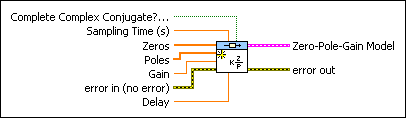
 |
Complete Complex Conjugate? specifies, when TRUE, to calculate the complex conjugate for any zero or pole that has only a real or pure complex root specified. The default is FALSE. | ||
 |
Sampling Time (s) defines whether the model represents a continuous-time system or a discrete-time system. If the model represents a continuous-time system, Sampling Time (s) must equal 0. If the model represents a discrete-time system, Sampling Time (s) must be greater than 0 and equal to the sampling rate, in seconds, of the discrete system. A value of -1 specifies that Sampling Time (s) is irrelevant. The default is 0.
|
||
 |
Zeros is the array of zeros of the SISO system. The zeros can be real or complex. If they are complex, they must be in complex conjugate pairs. | ||
|
Poles is the array of poles of the SISO system. The poles can be real or complex. If they are complex, they must be in complex conjugate pairs. | ||
|
Gain is the scalar gain of the SISO system. The default is NaN. | ||
 |
error in describes error conditions that occur before this node runs. This input provides standard error in functionality. | ||
|
Delay is the transport time delay that may exist in the system. The default is NaN. Refer to the LabVIEW Control Design User Manual for more information about delays. | ||
 |
Zero-Pole-Gain Model is the system model this VI creates. To access and modify the data in the model, use the Model Information VIs. | ||
 |
error out contains error information. This output provides standard error out functionality. |

CD Construct Zero-Pole-Gain Model (SISO Symbolic)

|
Complete Complex Conjugate? specifies, when TRUE, to calculate the complex conjugate for any zero or pole that has only a real or pure complex root specified. The default is FALSE. | ||||
|
Sampling Time (s) defines whether the model represents a continuous-time system or a discrete-time system. If the model represents a continuous-time system, Sampling Time (s) must equal 0. If the model represents a discrete-time system, Sampling Time (s) must be greater than 0 and equal to the sampling rate, in seconds, of the discrete system. A value of -1 specifies that Sampling Time (s) is irrelevant. The default is 0.
|
||||
 |
Symbolic Zeros is the array of zeros of the system. The zeros can be real or complex. If they are complex, they must be in complex conjugate pairs. | ||||
|
Symbolic Poles is the array of poles of the system. The poles can be real or complex. If they are complex, they must be in complex conjugate pairs. | ||||
 |
Symbolic Gain is the scalar gain of the system. The default is NaN. | ||||
|
error in describes error conditions that occur before this node runs. This input provides standard error in functionality. | ||||
|
Symbolic Delay is the symbolic representation of the transport time delay that may exist in the system. Refer to the LabVIEW Control Design User Manual for more information about delays. | ||||
|
Variables contains the name and value of each variable.
| ||||
|
Zero-Pole-Gain Model is the system model this VI creates. To access and modify the data in the model, use the Model Information VIs. | ||||
|
error out contains error information. This output provides standard error out functionality. |


CD Construct Zero-Pole-Gain Model (MIMO)

|
Complete Complex Conjugate? specifies, when TRUE, to calculate the complex conjugate for any zero or pole that has only a real or pure complex root specified. The default is FALSE. | ||||||
|
Sampling Time (s) defines whether the model represents a continuous-time system or a discrete-time system. If the model represents a continuous-time system, Sampling Time (s) must equal 0. If the model represents a discrete-time system, Sampling Time (s) must be greater than 0 and equal to the sampling rate, in seconds, of the discrete system. A value of -1 specifies that Sampling Time (s) is irrelevant. The default is 0.
|
||||||
 |
Zeros-Poles-Gains is an array of zero-pole-gain models that you can use to define the dynamics of a multiple-input single-output (MISO), single-input multiple-output (SIMO), or multiple-input multiple-output (MIMO) system.
| ||||||
|
error in describes error conditions that occur before this node runs. This input provides standard error in functionality. | ||||||
|
Zero-Pole-Gain Model is the system model this VI creates. To access and modify the data in the model, use the Model Information VIs. | ||||||
|
error out contains error information. This output provides standard error out functionality. |
CD Construct Zero-Pole-Gain Model (MIMO Symbolic)

|
Complete Complex Conjugate? specifies, when TRUE, to calculate the complex conjugate for any zero or pole that has only a real or pure complex root specified. The default is FALSE. | ||||||||
|
Sampling Time (s) defines whether the model represents a continuous-time system or a discrete-time system. If the model represents a continuous-time system, Sampling Time (s) must equal 0. If the model represents a discrete-time system, Sampling Time (s) must be greater than 0 and equal to the sampling rate, in seconds, of the discrete system. A value of -1 specifies that Sampling Time (s) is irrelevant. The default is 0.
|
||||||||
|
Symbolic Zero-Pole-Gain Model(s) is the symbolic representation of the zero-pole-gain model.
| ||||||||
|
error in describes error conditions that occur before this node runs. This input provides standard error in functionality. | ||||||||
|
Variables contains the name and value of each variable.
| ||||||||
|
Zero-Pole-Gain Model is the system model this VI creates. To access and modify the data in the model, use the Model Information VIs. | ||||||||
|
error out contains error information. This output provides standard error out functionality. |
CD Construct Zero-Pole-Gain Model Details
Only the SISO and SISO Symbolic instances of this VI support delays. To represent a delay in the model, you must specify the delay in this VI. Refer to the LabVIEW Control Design User Manual for more information about delays.