CD Construct Transfer Function Model VI
- Updated2023-03-14
- 9 minute(s) read
CD Construct Transfer Function Model VI
Owning Palette: Model Construction VIs
Requires: Control Design and Simulation Module
Creates a transfer function representation of a system using the Sampling Time (s), Numerator, Denominator, and Delay. This VI also produces a transfer function model which specifies the data in symbolic form. You must manually select the polymorphic instance to use.
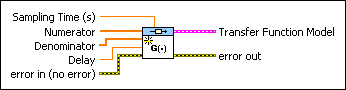
CD Construct Transfer Function Model (SISO)
 |
Sampling Time (s) defines whether the model represents a continuous-time system or a discrete-time system. If the model represents a continuous-time system, Sampling Time (s) must equal 0. If the model represents a discrete-time system, Sampling Time (s) must be greater than 0 and equal to the sampling rate, in seconds, of the discrete system. A value of -1 specifies that Sampling Time (s) is irrelevant. The default is 0.
|
||
 |
Numerator contains the constant coefficients, in ascending order, of a polynomial that represents the numerator of a SISO transfer function. The coefficients take the following form: b0 + b1s + ... +bmsm. | ||
|
Denominator contains the constant coefficients, in ascending order, of a polynomial that represents the denominator of a SISO transfer function. The coefficients take the following form: a0 + a1s + ... +ansn. | ||
|
Delay is the transport time delay that might exist in the system. Refer to the LabVIEW Control Design User Manual for more information about delays. | ||
 |
error in describes error conditions that occur before this node runs. This input provides standard error in functionality. | ||
 |
Transfer Function Model is the system model this VI creates. When the sampling time is zero (for continuous-time), the Numerator and Denominator collectively represent the mathematical model (in Laplace transformation) of a dynamic system H(s) that provides the relationship between the input U(s) and output Y(s) of the system. To access and modify the data in the model, use the Model Information VIs. | ||
 |
error out contains error information. This output provides standard error out functionality. |

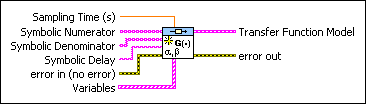
CD Construct Transfer Function Model (SISO Symbolic)
|
Sampling Time (s) defines whether the model represents a continuous-time system or a discrete-time system. If the model represents a continuous-time system, Sampling Time (s) must equal 0. If the model represents a discrete-time system, Sampling Time (s) must be greater than 0 and equal to the sampling rate, in seconds, of the discrete system. A value of -1 specifies that Sampling Time (s) is irrelevant. The default is 0.
|
||||
 |
Symbolic Numerator is the symbolic representation of the constant coefficients of a polynomial that represent the numerator of a SISO transfer function. The ith element of Symbolic Numerator is the coefficient of the ith order term of the polynomial. The index is zero-based. | ||||
|
Symbolic Denominator is the symbolic representation of the constant coefficients of a polynomial that represent the denominator of a SISO transfer function. The ith element of Symbolic Denominator is the coefficient of the ith order term of the polynomial. The index is zero-based. | ||||
 |
Symbolic Delay is the symbolic representation of the transport time delay that may exist in the system. Refer to the LabVIEW Control Design User Manual for more information about delays. | ||||
|
error in describes error conditions that occur before this node runs. This input provides standard error in functionality. | ||||
 |
Variables contains the name and value of each variable.
| ||||
|
Transfer Function Model is the numeric model that this VI evaluates using data from Variables. This VI converts empty array elements into numeric zeros. To access and modify the data in the model, use the Model Information VIs. | ||||
|
error out contains error information. This output provides standard error out functionality. |


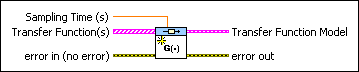
CD Construct Transfer Function Model (MIMO)
|
Sampling Time (s) defines whether the model represents a continuous-time system or a discrete-time system. If the model represents a continuous-time system, Sampling Time (s) must equal 0. If the model represents a discrete-time system, Sampling Time (s) must be greater than 0 and equal to the sampling rate, in seconds, of the discrete system. A value of -1 specifies that Sampling Time (s) is irrelevant. The default is 0.
|
||||
 |
Transfer Function(s) is an array of transfer function models that you can use to define the dynamics of a multiple-input single-output (MISO), a single-input multiple-output (SIMO), or a multiple-input multiple-output (MIMO) system.
| ||||
|
error in describes error conditions that occur before this node runs. This input provides standard error in functionality. | ||||
|
Transfer Function Model is the system model this VI creates. The size of the Transfer Function(s) array determines if the system is SISO, MIMO, MISO, or SIMO. To access and modify the data in the model, use the Model Information VIs. | ||||
|
error out contains error information. This output provides standard error out functionality. |
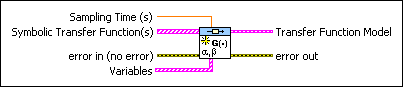
CD Construct Transfer Function Model (MIMO Symbolic)
|
Sampling Time (s) defines whether the model represents a continuous-time system or a discrete-time system. If the model represents a continuous-time system, Sampling Time (s) must equal 0. If the model represents a discrete-time system, Sampling Time (s) must be greater than 0 and equal to the sampling rate, in seconds, of the discrete system. A value of -1 specifies that Sampling Time (s) is irrelevant. The default is 0.
|
||||||
|
Symbolic Transfer Function(s) is the symbolic representation of the transfer functions that you can use to define the dynamics of a single-input single-output (SISO), multiple-input single-output (MISO), single-input multiple-output (SIMO), or multiple-input multiple-output (MIMO) system.
| ||||||
|
error in describes error conditions that occur before this node runs. This input provides standard error in functionality. | ||||||
|
Variables contains the name and value of each variable.
| ||||||
|
Transfer Function Model is the system model this VI creates. The size of the Transfer Function(s) array determines if the system is SISO, MIMO, MISO, or SIMO. To access and modify the data in the model, use the Model Information VIs. | ||||||
|
error out contains error information. This output provides standard error out functionality. |
CD Construct Transfer Function Model Details
Only the SISO and SISO Symbolic instances of this VI support delays. To represent a delay in the model, you must specify the delay in this VI. Refer to the LabVIEW Control Design User Manual for more information about delays.