Define 1D Heat PDE BC (VIRef) VI
- Updated2025-07-30
- 3 minute(s) read
Defines the boundary condition of partial differential equations. You must manually select the polymorphic instance to use.

Inputs/Outputs
 data
—
data
—
data is a variant that passes arbitrary values to the VI.  PDE in
—
PDE in
—
PDE in is the class that stores the data of the equation.  Boundary Condition
—
Boundary Condition
—
Boundary Condition is a strictly typed reference to the VI that implements the boundary condition. Create this VI by starting from the VI template located in labview\vi.lib\gmath\pde.llb\Common\1D Evolutionary PDE Func Template.vit.  type
—
type
—
type specifies the type of the boundary condition.
position
—
position specifies the position of the boundary condition.
 error in (no error)
—
error in (no error)
—
error in describes error conditions that occur before this node runs. This input provides standard error in functionality.  PDE out
—
PDE out
—
PDE out returns PDE in with the boundary condition.  error out
—
error out
—
error out contains error information. This output provides standard error out functionality. |
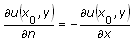
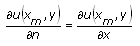
The following table gives the definitions of a normal derivative for one-dimensional equations and for two-dimensional equations defined on a rectangular domain.
| Position | Normal Derivative (One-Dimension) | Normal Derivative (Rectangular Domain) |
|---|---|---|
| Start X | 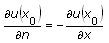 |
 |
| End X | 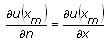 |
 |
| Start Y | N/A | 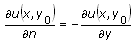 |
| End Y | N/A | 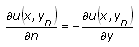 |
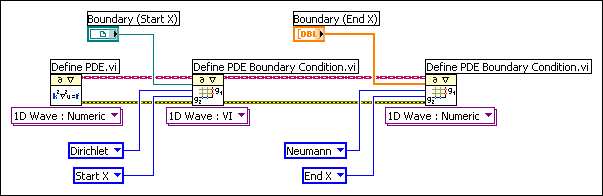
The following block diagram is an example of defining the boundary condition for a one-dimensional wave equation. The boundary condition at Start X is Dirichlet, which the VI defines. The boundary condition at End X is Neumann, which the numeric array defines.
Examples
Refer to the following example files included with LabVIEW.
- labview\examples\Mathematics\Differential Equations - PDE\PDE Flexible Element.vi
- labview\examples\Mathematics\Differential Equations - PDE\PDE String Vibration.vi
- labview\examples\Mathematics\Differential Equations - PDE\PDE Thermal Distribution.vi