2D Helmholtz PDE Rendering (Polygon Domain) VI
- Updated2025-07-30
- 3 minute(s) read
Renders the solution of the partial differential equation. You must manually select the polymorphic instance to use.

Inputs/Outputs
 plot style
—
plot style
—
plot style specifies how LabVIEW draws the solution for PDE Plot.
 PDE in
—
PDE in
—
PDE in is the class that stores the data of the equation.  U(x, y)
—
U(x, y)
—
U(x, y) specifies the solution of the equation in Grid Points from the PDE Solver VI.  Grid Points
—
Grid Points
—
Grid Points specifies the grid points for the equation.
 error in (no error)
—
error in (no error)
—
error in describes error conditions that occur before this node runs. This input provides standard error in functionality.  PDE out
—
PDE out
—
PDE out returns PDE in unchanged.  PDE Plot
—
PDE Plot
—
PDE Plot returns a reference to a 3D scene object. Wire this output to the 3D picture control to view the solution.  Triangulation Plot
—
Triangulation Plot
—
Triangulation Plot returns an XY graph that illustrates triangulation.  error out
—
error out
—
error out contains error information. This output provides standard error out functionality. |
 X
—
X
—
Before you use the PDE Rendering VI, use the PDE Solver VI to solve the equation.
The following block diagram illustrates how to set the scale offset and multiplier of PDE Plot by X Scale and Y Scale.
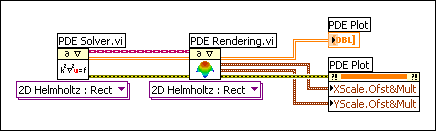
If you do not set the scale offset and multiplier, LabVIEW uses the default settings of the intensity graph.
Examples
Refer to the following example files included with LabVIEW.
- labview\examples\Mathematics\Differential Equations - PDE\PDE Flexible Element.vi
- labview\examples\Mathematics\Differential Equations - PDE\PDE String Vibration.vi
- labview\examples\Mathematics\Differential Equations - PDE\PDE Thermal Distribution.vi