SystemLink Enterprise Network Interactions
- Updated2025-11-26
- 2 minute(s) read
SystemLink Enterprise Network Interactions
Learn about the networked components and encrypted protocols SystemLink Enterprise uses.
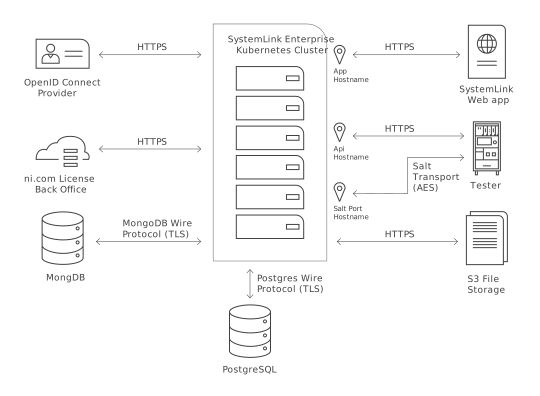
| Component or Protocol | Description |
|---|---|
| SystemLink Enterprise Kubernetes Cluster |
The SystemLink Enterprise
Kubernetes Cluster in the Linux Kubernetes cluster
hosts the pods that make up the following components.
For more information on cluster requirements, refer to Related information. |
| SystemLink Web Application |
The SystemLink Web Application is the online utility that users can access to interact with SystemLink. |
| Targets |
Targets are the systems that SystemLink manages the software and configuration. These systems can have Windows and Linux Real-Time operating systems. Targets communicate with SystemLink over HTTPS and the SaltStack TCP protocol. Regardless of protocol, test systems initiate all communication to the server. For information on adding a target to your SystemLink server, refer to Setting Up a SystemLink Client. SystemLink communicates tags, files, assets, and test results over HTTPS. Salt jobs and pillars communicate over the AES encrypted Salt TCP transport. Salt jobs are used for installing software and for changing target configuration from SystemLink server. Salt pillars are used to transfer credentials and certificates. Salt manages the SystemLink server certificates. Target nodes do not require administrators to manage these certificates. For an overview of the Salt TCP Transport, refer to the SaltStack documentation. When SystemLink approves a target, the target becomes a managed node. SystemLink also securely transfers the configuration, certificates, and credentials necessary for authentication with the role-based SystemLink Server access control system. SystemLink Client APIs include an auto configuration VI that automatically consumes these credentials. You do not have to include secrets, such as credentials, in your test application code. |
| MongoDB |
MongoDB is a document database. SystemLink uses the MongoDB wire protocol to communicate with the MongoDB instance. MongoDB supports TLS connections. For more information, refer to the MongoDB TLS documentation. |
| File Storage |
File Storage refers to the Amazon S3 or Azure Blob storage system that the SystemLink File Ingestion Service uses. |
| Identity Provider |
The Identity Provider is the service SystemLink uses to authenticate users and log users into the SystemLink web application. SystemLink Enterprise supports only OpenID Connect identity providers. For more information on how to connect your provider to SystemLink, refer to Configuring OpenID Connect Client Access. |
| PostgreSQL |
PostgreSQL is a relational database management system. SystemLink uses PostgreSQL for data storage. |
| Elasticsearch |
Elasticsearch is a search engine. SystemLink uses Elasticsearch to improve search capabilities. |
Related Information
- Components of a SystemLink Enterprise System
SystemLink Enterprise implements a server-client architecture to transmit data over a connected network between your systems and server. Use the minimum required SystemLink Enterprise system components as a starting point for building your system.
- Setting up a SystemLink Client
Install SystemLink Client to establish a connection between your SystemLink server and a remote target.
- Configuring File Storage
Several SystemLink Enterprise services require a file storage provider.
- Configuring OpenID Connect Client Access
Configure the application to use your authentication provider. SystemLink Enterprise uses the OpenID Connect protocol to authenticate users from an external authentication provider.
- Salt Communication
- MongoDB TLS
- Network Security Considerations
SystemLink Enterprise is hosted in a Kubernetes cluster. SystemLink Enterprise connects to test systems to aggregate data for monitoring and analysis.