RFmxSpecAn PhaseNoise Configure Range (Array) VI
- Updated2025-10-13
- 3 minute(s) read
Configures an array of the offset range, RBW percentage and averaging count when you set the PhaseNoise Range Definition property to Manual.
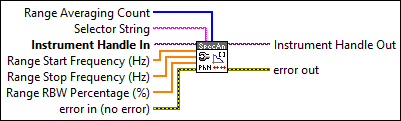
Inputs/Outputs
 Range Averaging Count
—
Range Averaging Count
—
Range Averaging Count specifies the averaging count for the specified range. The default value is 10.  Selector String
—
Selector String
—
Selector String specifies a selector string comprising of the signal name. If you do not specify the signal name, the default signal instance is used. The default value is "" (empty string). Example: "" "signal::sig1" You can use the RFmxSpecAn Build Signal String VI to build the selector string.  Instrument Handle In
—
Instrument Handle In
—
Instrument Handle In specifies the RFmx session refnum. Instrument Handle In is obtained from the RFmxInstr Initialize NIRFSA VI.  Range Start Frequency (Hz)
—
Range Start Frequency (Hz)
—
Range Start Frequency specifies the start frequency of the offset frequency for the specified subrange when you set the PhaseNoise Range Definition property to Auto. This value is expressed in Hz. The default value is 1000..
Range Stop Frequency (Hz)
—
Range Stop Frequency Specifies the stop offset frequency for the specified subrange when you set the PhaseNoise Range Definition property to Manual. This value is expressed in Hz. The default value is 1000000.
Range RBW Percentage (%)
—
Range RBW Percentage specifies the RBW as a percentage of the start frequency of the specified subrange when you set the PhaseNoise Range Definition property to Manual. This value is expressed as a percentage. The default value is 10.  error in (no error)
—
error in (no error)
—
error in describes error conditions that occur before this node runs. This input provides standard error in functionality.  Instrument Handle Out
—
Instrument Handle Out
—
Instrument Handle Out passes a reference of your RFmx session to the next VI.  error out
—
error out
—
error out contains error information. This output provides standard error out functionality. |