SVD Decomposition VI
- Updated2023-02-21
- 8 minute(s) read
SVD Decomposition VI
Owning Palette: Linear Algebra VIs
Requires: Multicore Analysis and Sparse Matrix Toolkit
Computes the singular value decomposition (SVD) of a matrix A.
Wire data to the A input to determine the polymorphic instance to use or manually select the instance.
SVD Decomposition (DBL)

 |
A specifies an m × n matrix with m rows and n columns. | ||||
 |
singular values only? specifies whether to compute the singular values only. The default is FALSE. If singular values only? is TRUE, this VI does not compute Matrix U and Matrix V. | ||||
 |
SVD option specifies how this VI performs the decomposition.
|
||||
 |
error in describes error conditions that occur before this node runs. This input provides standard error in functionality. | ||||
 |
Vector S returns the singular values of A in descending order. The values in Vector S are the diagonal elements of Matrix S. | ||||
 |
Matrix U returns the decomposed U matrix. The columns of Matrix U compose an orthogonal set. Matrix U is empty if singular values only? is TRUE. | ||||
|
Matrix S returns the decomposed S matrix. Matrix S is a diagonal matrix whose diagonal elements are the values from Vector S, or the singular values of A in descending order. | ||||
|
Matrix V returns the decomposed V matrix. The columns of Matrix V compose an orthogonal set. Matrix V is empty if singular values only? is TRUE. | ||||
 |
error out contains error information. This output provides standard error out functionality. |
SVD Decomposition (SGL)

 |
A specifies an m × n matrix with m rows and n columns. | ||||
|
singular values only? specifies whether to compute the singular values only. The default is FALSE. If singular values only? is TRUE, this VI does not compute Matrix U and Matrix V. | ||||
|
SVD option specifies how this VI performs the decomposition.
|
||||
|
error in describes error conditions that occur before this node runs. This input provides standard error in functionality. | ||||
 |
Vector S returns the singular values of A in descending order. The values in Vector S are the diagonal elements of Matrix S. | ||||
 |
Matrix U returns the decomposed U matrix. The columns of Matrix U compose an orthogonal set. Matrix U is empty if singular values only? is TRUE. | ||||
|
Matrix S returns the decomposed S matrix. Matrix S is a diagonal matrix whose diagonal elements are the values from Vector S, or the singular values of A in descending order. | ||||
|
Matrix V returns the decomposed V matrix. The columns of Matrix V compose an orthogonal set. Matrix V is empty if singular values only? is TRUE. | ||||
|
error out contains error information. This output provides standard error out functionality. |
SVD Decomposition (CDB)

 |
A specifies an m × n matrix with m rows and n columns. | ||||
|
singular values only? specifies whether to compute the singular values only. The default is FALSE. If singular values only? is TRUE, this VI does not compute Matrix U and Matrix V. | ||||
|
SVD option specifies how this VI performs the decomposition.
|
||||
|
error in describes error conditions that occur before this node runs. This input provides standard error in functionality. | ||||
|
Vector S returns the singular values of A in descending order. The values in Vector S are the diagonal elements of Matrix S. | ||||
 |
Matrix U returns the decomposed U matrix. The columns of Matrix U compose an orthogonal set. Matrix U is empty if singular values only? is TRUE. | ||||
|
Matrix S returns the decomposed S matrix. Matrix S is a diagonal matrix whose diagonal elements are the values from Vector S, or the singular values of A in descending order. | ||||
|
Matrix V returns the decomposed V matrix. The columns of Matrix V compose an orthogonal set. Matrix V is empty if singular values only? is TRUE. | ||||
|
error out contains error information. This output provides standard error out functionality. |
SVD Decomposition (CSG)
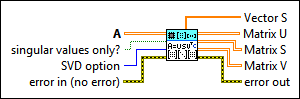
 |
A specifies an m × n matrix with m rows and n columns. | ||||
|
singular values only? specifies whether to compute the singular values only. The default is FALSE. If singular values only? is TRUE, this VI does not compute Matrix U and Matrix V. | ||||
|
SVD option specifies how this VI performs the decomposition.
|
||||
|
error in describes error conditions that occur before this node runs. This input provides standard error in functionality. | ||||
|
Vector S returns the singular values of A in descending order. The values in Vector S are the diagonal elements of Matrix S. | ||||
 |
Matrix U returns the decomposed U matrix. The columns of Matrix U compose an orthogonal set. Matrix U is empty if singular values only? is TRUE. | ||||
|
Matrix S returns the decomposed S matrix. Matrix S is a diagonal matrix whose diagonal elements are the values from Vector S, or the singular values of A in descending order. | ||||
|
Matrix V returns the decomposed V matrix. The columns of Matrix V compose an orthogonal set. Matrix V is empty if singular values only? is TRUE. | ||||
|
error out contains error information. This output provides standard error out functionality. |
SVD Decomposition Details
The following table lists the support characteristics of this VI.
| Supported on RT targets | Yes |
| Suitable for bounded execution times on RT | Yes |
Refer to the Details section in the SVD Decomposition VI for more details about this VI.