Multi-channel FFT VI
- Updated2023-02-21
- 7 minute(s) read
Multi-channel FFT VI
Owning Palette: Transforms VIs
Requires: Multicore Analysis and Sparse Matrix Toolkit
Computes the fast Fourier transform (FFT) of each channel signal of the input matrix X.
Wire data to the X input to determine the polymorphic instance to use or manually select the instance.
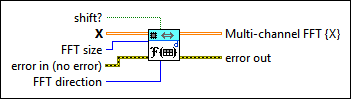
2D Multi-channel FFT (DBL)
 |
shift? specifies whether this VI shifts the DC component to the center of each channel FFT result. The default is FALSE. | ||||
 |
X specifies the multi-channel input signal. | ||||
 |
FFT size specifies the length of the FFT you want to perform on each channel signal. If FFT size is greater than the length of each channel signal in X, this VI adds zeros to the each channel signal in X to match the size of FFT size. If FFT size is less than the length of each channel signal in X, this VI uses only the first n elements of each channel signal in X to perform the FFT, where n is the FFT size. If FFT size is less than or equal to zero, this VI does not zero pad or truncate X. | ||||
 |
error in describes error conditions that occur before this node runs. This input provides standard error in functionality. | ||||
|
FFT direction specifies whether to perform FFT on each row of X or each column of X.
|
||||
 |
Multi-channel FFT {X} returns each channel FFT result of X. | ||||
 |
error out contains error information. This output provides standard error out functionality. |
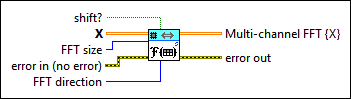
2D Multi-channel FFT (SGL)
|
shift? specifies whether this VI shifts the DC component to the center of each channel FFT result. The default is FALSE. | ||||
 |
X specifies the multi-channel input signal. | ||||
|
FFT size specifies the length of the FFT you want to perform on each channel signal. If FFT size is greater than the length of each channel signal in X, this VI adds zeros to the each channel signal in X to match the size of FFT size. If FFT size is less than the length of each channel signal in X, this VI uses only the first n elements of each channel signal in X to perform the FFT, where n is the FFT size. If FFT size is less than or equal to zero, this VI does not zero pad or truncate X. | ||||
|
error in describes error conditions that occur before this node runs. This input provides standard error in functionality. | ||||
|
FFT direction specifies whether to perform FFT on each row of X or each column of X.
|
||||
 |
Multi-channel FFT {X} returns each channel FFT result of X. | ||||
|
error out contains error information. This output provides standard error out functionality. |
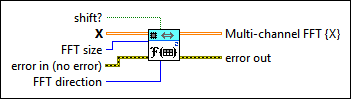
2D Multi-channel FFT (CDB)
|
shift? specifies whether this VI shifts the DC component to the center of each channel FFT result. The default is FALSE. | ||||
 |
X specifies the multi-channel input signal. | ||||
|
FFT size specifies the length of the FFT you want to perform on each channel signal. If FFT size is greater than the length of each channel signal in X, this VI adds zeros to the each channel signal in X to match the size of FFT size. If FFT size is less than the length of each channel signal in X, this VI uses only the first n elements of each channel signal in X to perform the FFT, where n is the FFT size. If FFT size is less than or equal to zero, this VI does not zero pad or truncate X. | ||||
|
error in describes error conditions that occur before this node runs. This input provides standard error in functionality. | ||||
|
FFT direction specifies whether to perform FFT on each row of X or each column of X.
|
||||
|
Multi-channel FFT {X} returns each channel FFT result of X. | ||||
|
error out contains error information. This output provides standard error out functionality. |
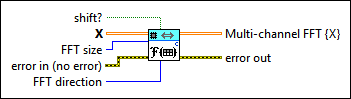
2D Multi-channel FFT (CSG)
|
shift? specifies whether this VI shifts the DC component to the center of each channel FFT result. The default is FALSE. | ||||
 |
X specifies the multi-channel input signal. | ||||
|
FFT size specifies the length of the FFT you want to perform on each channel signal. If FFT size is greater than the length of each channel signal in X, this VI adds zeros to the each channel signal in X to match the size of FFT size. If FFT size is less than the length of each channel signal in X, this VI uses only the first n elements of each channel signal in X to perform the FFT, where n is the FFT size. If FFT size is less than or equal to zero, this VI does not zero pad or truncate X. | ||||
|
error in describes error conditions that occur before this node runs. This input provides standard error in functionality. | ||||
|
FFT direction specifies whether to perform FFT on each row of X or each column of X.
|
||||
|
Multi-channel FFT {X} returns each channel FFT result of X. | ||||
|
error out contains error information. This output provides standard error out functionality. |
Multi-channel FFT Details
The following table lists the support characteristics of this VI.
| Supported on RT targets | Yes |
| Suitable for bounded execution times on RT | Yes |