LabVIEW Multicore Analysis and Sparse Matrix Toolkit API Reference

Create Special Matrix VI

  • Updated2023-02-21
  • 9 minute(s) read

Create Special Matrix VI

Owning Palette: Linear Algebra VIs

Requires: Multicore Analysis and Sparse Matrix Toolkit

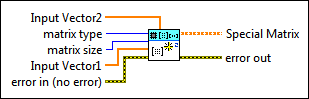
Generates a special matrix based on matrix type.

You must manually select the polymorphic instance you want to use.

Let n represent matrix size, X represent Input Vector1, nx represent the size of X, Y represent Input Vector2, ny represent the size of Y, B represent the output Special Matrix, and bi,j represent the element of B in the ith row and jth column.

Details  

Create Special Matrix (DBL)

Input Vector2 specifies the Y variable to construct a special matrix.
matrix type specifies the type of special matrix to generate.

0Identity (default)—Generates an n-by-n identity matrix. This VI ignores Input Vector1 and Input Vector2.
1Diagonal—Generates an nx-by-nx diagonal matrix whose diagonal elements are the elements of X. This VI ignores Input Vector2.
2Toeplitz—Generates an nx-by-ny Toeplitz matrix, which has X as its first column and Y as its first row. If the first element of X and Y are different, this VI uses the first element of X.
3Vandermonde—Generates an nx-by-nx Vandermonde matrix whose columns are powers of the elements of X. The elements of a Vandermonde matrix are:

bi,j = xinxj –1

where i, j=0…nx–1. This VI ignores Input Vector2.
4Companion—Generates an (nx-1)-by-(nx-1) companion matrix. If vector X is a vector of a polynomial coefficient, the first element of X is the coefficient of the highest order, the last element of X is the constant term in the polynomial, the corresponding companion matrix is constructed as follows: the first row is

and the subdiagonal elements of B are 1.

The eigenvalues of a companion matrix contain the roots of the corresponding polynomial. This VI ignores Input Vector2.
5Hankel—Generates an nx-by-ny Hankel matrix, where X is the first column and Y is the last row of the matrix. If the first element of Y and the last element of X are different, this VI uses the last element of X.
matrix size specifies the dimension size of Special Matrix. The default is 1. This VI ignores matrix size unless the value of matrix type is Identity.
Input Vector1 specifies the X variable to construct a special matrix.
error in describes error conditions that occur before this node runs. This input provides standard error in functionality.
Special Matrix returns the generated matrix.
error out contains error information. This output provides standard error out functionality.

Create Special Matrix (SGL)

Input Vector2 specifies the Y variable to construct a special matrix.
matrix type specifies the type of special matrix to generate.

0Identity (default)—Generates an n-by-n identity matrix. This VI ignores Input Vector1 and Input Vector2.
1Diagonal—Generates an nx-by-nx diagonal matrix whose diagonal elements are the elements of X. This VI ignores Input Vector2.
2Toeplitz—Generates an nx-by-ny Toeplitz matrix, which has X as its first column and Y as its first row. If the first element of X and Y are different, this VI uses the first element of X.
3Vandermonde—Generates an nx-by-nx Vandermonde matrix whose columns are powers of the elements of X. The elements of a Vandermonde matrix are:

bi,j = xinxj –1

where i, j=0…nx–1. This VI ignores Input Vector2.
4Companion—Generates an (nx-1)-by-(nx-1) companion matrix. If vector X is a vector of a polynomial coefficient, the first element of X is the coefficient of the highest order, the last element of X is the constant term in the polynomial, the corresponding companion matrix is constructed as follows: the first row is

and the subdiagonal elements of B are 1.

The eigenvalues of a companion matrix contain the roots of the corresponding polynomial. This VI ignores Input Vector2.
5Hankel—Generates an nx-by-ny Hankel matrix, where X is the first column and Y is the last row of the matrix. If the first element of Y and the last element of X are different, this VI uses the last element of X.
matrix size specifies the dimension size of Special Matrix. The default is 1. This VI ignores matrix size unless the value of matrix type is Identity.
Input Vector1 specifies the X variable to construct a special matrix.
error in describes error conditions that occur before this node runs. This input provides standard error in functionality.
Special Matrix returns the generated matrix.
error out contains error information. This output provides standard error out functionality.

Create Special Matrix (CDB)

Input Vector2 specifies the Y variable to construct a special matrix.
matrix type specifies the type of special matrix to generate.

0Identity (default)—Generates an n-by-n identity matrix. This VI ignores Input Vector1 and Input Vector2.
1Diagonal—Generates an nx-by-nx diagonal matrix whose diagonal elements are the elements of X. This VI ignores Input Vector2.
2Toeplitz—Generates an nx-by-ny Toeplitz matrix, which has X as its first column and Y as its first row. If the first element of X and Y are different, this VI uses the first element of X.
3Vandermonde—Generates an nx-by-nx Vandermonde matrix whose columns are powers of the elements of X. The elements of a Vandermonde matrix are:

bi,j = xinxj –1

where i, j=0…nx–1. This VI ignores Input Vector2.
4Companion—Generates an (nx-1)-by-(nx-1) companion matrix. If vector X is a vector of a polynomial coefficient, the first element of X is the coefficient of the highest order, the last element of X is the constant term in the polynomial, the corresponding companion matrix is constructed as follows: the first row is

and the subdiagonal elements of B are 1.

The eigenvalues of a companion matrix contain the roots of the corresponding polynomial. This VI ignores Input Vector2.
5Hankel—Generates an nx-by-ny Hankel matrix, where X is the first column and Y is the last row of the matrix. If the first element of Y and the last element of X are different, this VI uses the last element of X.
matrix size specifies the dimension size of Special Matrix. The default is 1. This VI ignores matrix size unless the value of matrix type is Identity.
Input Vector1 specifies the X variable to construct a special matrix.
error in describes error conditions that occur before this node runs. This input provides standard error in functionality.
Special Matrix returns the generated matrix.
error out contains error information. This output provides standard error out functionality.

Create Special Matrix (CSG)

Input Vector2 specifies the Y variable to construct a special matrix.
matrix type specifies the type of special matrix to generate.

0Identity (default)—Generates an n-by-n identity matrix. This VI ignores Input Vector1 and Input Vector2.
1Diagonal—Generates an nx-by-nx diagonal matrix whose diagonal elements are the elements of X. This VI ignores Input Vector2.
2Toeplitz—Generates an nx-by-ny Toeplitz matrix, which has X as its first column and Y as its first row. If the first element of X and Y are different, this VI uses the first element of X.
3Vandermonde—Generates an nx-by-nx Vandermonde matrix whose columns are powers of the elements of X. The elements of a Vandermonde matrix are:

bi,j = xinxj –1

where i, j=0…nx–1. This VI ignores Input Vector2.
4Companion—Generates an (nx-1)-by-(nx-1) companion matrix. If vector X is a vector of a polynomial coefficient, the first element of X is the coefficient of the highest order, the last element of X is the constant term in the polynomial, the corresponding companion matrix is constructed as follows: the first row is

and the subdiagonal elements of B are 1.

The eigenvalues of a companion matrix contain the roots of the corresponding polynomial. This VI ignores Input Vector2.
5Hankel—Generates an nx-by-ny Hankel matrix, where X is the first column and Y is the last row of the matrix. If the first element of Y and the last element of X are different, this VI uses the last element of X.
matrix size specifies the dimension size of Special Matrix. The default is 1. This VI ignores matrix size unless the value of matrix type is Identity.
Input Vector1 specifies the X variable to construct a special matrix.
error in describes error conditions that occur before this node runs. This input provides standard error in functionality.
Special Matrix returns the generated matrix.
error out contains error information. This output provides standard error out functionality.

Create Special Matrix Details

The following table lists the support characteristics of this VI.

Supported on RT targets Yes
Suitable for bounded execution times on RT Yes

Log in to get a better experience