Period VI
- Updated2023-02-21
- 6 minute(s) read
Period VI
Owning Palette: Timing VIs
Requires: Jitter Analysis Toolkit
Measures the durations of portions of a waveform. Wire data to the rising/falling input to determine the polymorphic instance to use or manually select the instance.
Period (clock)
Use this polymorphic instance to measure the periods of cycles in waveforms with evenly spaced rising and falling transitions.

 |
level crossings contains information about the locations of level crossings in the original waveform. You can use the Level Crossing VI to generate this cluster.
| ||||||||||||||
 |
error in describes error conditions that occur before this node runs. This input provides standard error in functionality. | ||||||||||||||
 |
rising/falling specifies the direction of the transition at which to begin the measurement. This VI begins measuring at the first transition of that direction in the waveform.
|
||||||||||||||
 |
period sequence is an array of durations of cycles in the waveform, in seconds. In other words, the values represent the differences between the time that successive transitions of the same direction fall on the crossing level. | ||||||||||||||
|
frequency sequence is an array of the frequencies of cycles in the waveform. The elements in frequency sequence are the reciprocals of the period sequence values. | ||||||||||||||
 |
sequence timestamps returns timing information about the waveform that allows you to identify the times at which measurements in the corresponding sequence occur.
| ||||||||||||||
 |
error out contains error information. This output provides standard error out functionality. |


Period (data)
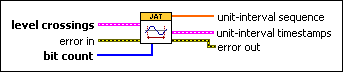
Use this polymorphic instance to measure the unit intervals in waveforms with unevenly spaced rising and falling transitions. When transitions are unevenly spaced, unit intervals provide a more useful measure of time than cycle periods.
|
level crossings contains information about the locations of level crossings in the original waveform. You can use the Level Crossing VI to generate this cluster.
| ||||||||||||||
|
error in describes error conditions that occur before this node runs. This input provides standard error in functionality. | ||||||||||||||
 |
bit count specifies the number of bits between pairs of transitions of the opposite direction in the waveform. Each element of bit count corresponds to an element of unit-interval sequence. | ||||||||||||||
|
unit-interval sequence is an array of unit intervals in the waveform, in seconds. To calculate these values, LabVIEW divides the time between successive level crossings by the number of bits between those locations, as specified by bit count. | ||||||||||||||
|
unit-interval timestamps returns timing information about the waveform that allows you to identify the times at which measurements in the corresponding sequence occur.
| ||||||||||||||
|
error out contains error information. This output provides standard error out functionality. |
Example
Refer to the Simulated Signal with Jitter VI in the labview\examples\Jitter Analysis\Jitter Measurements directory for an example of using the Period VI.