xHERK (Hermitian Matrix Rank-k Update) VI
- Updated2023-02-21
- 6 minute(s) read
xHERK (Hermitian Matrix Rank-k Update) VI
Owning Palette: LVCUBLAS
Requires: GPU Analysis Toolkit
Calculates a symmetric rank-k update of a symmetric matrix. When you wire data to A in and C, this VI automatically selects the first available instance.
To use a different instance, you must manually select the polymorphic instance you want to use.
xHERK (Hermitian Matrix Rank-k Update) (aAconj(A) + bC)
The connector pane displays the default data types for this polymorphic instance.
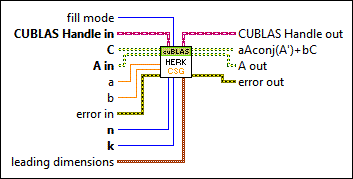
 |
fill mode specifies the triangular portion of the matrix A in the calculation.
|
||||
 |
CUBLAS Handle in specifies the initialized CUBLAS library to use for the BLAS calculation. For example, you can wire the CUBLAS Handle output from the Initialize Library VI to specify the CUBLAS handle to the CUBLAS library you already initialized. This input also determines the device that executes the function. | ||||
 |
C specifies the Hermitian matrix C stored on the device. The diagonal elements of C have a zero imaginary component. The calculation ignores the diagonal elements. This input specifies a class that can contain the following data types:
|
||||
|
A in specifies the matrix A stored on the device. This input specifies a class that can contain the following data types:
|
||||
 |
a represents alpha and specifies the scalar operand in the product alpha*A*conj(A') and alpha*conj(A')*A. The default is 1. | ||||
|
b represents beta and specifies the scalar operand in the product beta*C. The default is 0. | ||||
 |
error in describes error conditions that occur before this node runs. This input provides standard error in functionality. | ||||
|
n specifies the number of rows to use in matrix op(A) and C. | ||||
|
k specifies the number of columns to use in matrix op(A). | ||||
 |
leading dimensions specifies the column dimension to index consecutive rows. Use lda and ldc for A and C, respectively. | ||||
 |
CUBLAS Handle out returns the handle that defines the BLAS operation. | ||||
 |
aAconj(A')+bC returns a complex matrix with the same dimensions as C. For the elements of the first n rows and n columns of the triangular component defined by fill mode, aAconj(A')+bC returns the result of the calculation. Diagonal elements with non-zero imaginary component are set to zero. For any other elements, aAconj(A')+bC returns the value of the element in C with the same index. | ||||
|
A out returns the triangular matrix A stored on the device. | ||||
 |
error out contains error information. This output provides standard error out functionality. |
xHERK (Hermitian Matrix Rank-k Update) (aconj(A')A + bC)
The connector pane displays the default data types for this polymorphic instance.

|
fill mode specifies the triangular portion of the matrix A in the calculation.
|
||||
|
CUBLAS Handle in specifies the initialized CUBLAS library to use for the BLAS calculation. For example, you can wire the CUBLAS Handle output from the Initialize Library VI to specify the CUBLAS handle to the CUBLAS library you already initialized. This input also determines the device that executes the function. | ||||
|
C specifies the Hermitian matrix C stored on the device. The diagonal elements of C have a zero imaginary component. The calculation ignores the diagonal elements. This input specifies a class that can contain the following data types:
|
||||
|
A in specifies the matrix A stored on the device. This input specifies a class that can contain the following data types:
|
||||
|
a represents alpha and specifies the scalar operand in the product alpha*conj(A')*A. The default is 1. | ||||
|
b represents beta and specifies the scalar operand in the product beta*C. The default is 0. | ||||
|
error in describes error conditions that occur before this node runs. This input provides standard error in functionality. | ||||
|
n specifies the number of rows to use in matrix op(A') and C. | ||||
|
k specifies the number of columns to use in matrix op(A'). | ||||
|
leading dimensions specifies the column dimension to index consecutive rows. Use lda and ldc for A and C, respectively. | ||||
|
CUBLAS Handle out returns the handle that defines the BLAS operation. | ||||
|
aconj(A')A+bC returns a complex matrix with the same dimensions as C. For the elements of the first n rows and n columns of the triangular component defined by fill mode, aconj(A')A+bC returns the result of the calculation. Diagonal elements with non-zero imaginary component are set to zero. For any other elements, aconj(A')A+bC returns the value of the element in C with the same index. | ||||
|
A out returns the triangular matrix A stored on the device. | ||||
|
error out contains error information. This output provides standard error out functionality. |
xHERK (Hermitian Matrix Rank-k Update) Details
For more information on how to use this VI, refer to the Designing the Block Diagram to Compute on a GPU Device topic.
For more information about the CUBLAS library and BLAS operations, refer to the NVIDIA GPU Computing Documentation website at nvidia.com and download the CUBLAS Library User Guide.
Refer to the BLAS (Basic Linear Algebra Subprograms) website at netlib.org for more information on BLAS functions.