Step Signals and Step Responses (Advanced Signal Processing Toolkit or Control Design and Simulation Module)
- Updated2023-03-14
- 2 minute(s) read
A step signal is a signal that switches from an initial value a to another value b in a very short time. You can generate this signal by creating an array that begins with a series of a and then shifts to a series of b. For example, if you use zero as a and one as b, you can create an array that begins with a series of zeros and then shifts to a series of ones, such as "0, 0, 0, 0, 0, 0, 1, 1, 1, 1, 1, 1, 1, 1, 1". Use the Build Waveform (Analog Waveform) function to convert this array to a waveform signal.
Use step signals as stimulus signals to estimate dynamic systems from step responses. The following figure shows an example of a step stimulus signal and the corresponding step response.
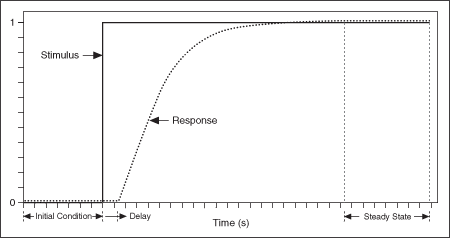
A step stimulus signal and the corresponding step response contain the following phases:
- Initial Condition—A time period when both the step stimulus signal and the step response equal zero.
- t0—The time point when the step stimulus signal starts to change.
- Delay—A time period when the step stimulus signal equals one and the step response equals zero.
- Steady State—A time period when the step stimulus signal equals one and the gradient of the step response equals zero.