CD Set Sampling Time to Model VI
- Updated2023-03-14
- 4 minute(s) read
CD Set Sampling Time to Model VI
Owning Palette: Model Information VIs
Requires: Control Design and Simulation Module
Sets the sampling time of the system. Wire data to the State-Space Model In input to determine the polymorphic instance to use or manually select the instance.
CD Set Sampling Time to Model (State-Space)

 |
State-Space Model In contains a mathematical representation of and information about the system for which this VI sets sampling time. |
 |
Sampling Time (s) specifies the sampling time of the model. Sampling Time (s) defines whether the model represents a continuous-time system or a discrete-time system. If the model represents a continuous-time system, Sampling Time (s) must equal 0. If the model represents a discrete-time system, Sampling Time (s) must be greater than 0 and equal to the sampling rate, in seconds, of the discrete system. A value of -1 specifies that Sampling Time (s) is irrelevant. The default is 0. |
 |
error in describes error conditions that occur before this node runs. This input provides standard error in functionality. |
 |
Model Out is the modified system model with a new sampling time. To access and modify the data in the model, use the Model Information VIs. |
 |
error out contains error information. This output provides standard error out functionality. |
CD Set Sampling Time to Model (Transfer Function)

|
Transfer Function Model In contains a mathematical representation of and information about the system for which this VI sets sampling time. |
|
Sampling Time (s) specifies the sampling time of the model. Sampling Time (s) defines whether the model represents a continuous-time system or a discrete-time system. If the model represents a continuous-time system, Sampling Time (s) must equal 0. If the model represents a discrete-time system, Sampling Time (s) must be greater than 0 and equal to the sampling rate, in seconds, of the discrete system. A value of -1 specifies that Sampling Time (s) is irrelevant. The default is 0. |
|
error in describes error conditions that occur before this node runs. This input provides standard error in functionality. |
|
Model Out is the modified system model with a new sampling time. To access and modify the data in the model, use the Model Information VIs. |
|
error out contains error information. This output provides standard error out functionality. |
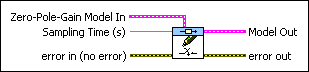
CD Set Sampling Time to Model (Zero-Pole-Gain)
|
Zero-Pole-Gain Model In contains a mathematical representation of and information about the system for which this VI sets sampling time. |
|
Sampling Time (s) specifies the sampling time of the model. Sampling Time (s) defines whether the model represents a continuous-time system or a discrete-time system. If the model represents a continuous-time system, Sampling Time (s) must equal 0. If the model represents a discrete-time system, Sampling Time (s) must be greater than 0 and equal to the sampling rate, in seconds, of the discrete system. A value of -1 specifies that Sampling Time (s) is irrelevant. The default is 0. |
|
error in describes error conditions that occur before this node runs. This input provides standard error in functionality. |
|
Model Out is the modified system model with a new sampling time. To access and modify the data in the model, use the Model Information VIs. |
|
error out contains error information. This output provides standard error out functionality. |