CD Poles VI
- Updated2023-03-14
- 4 minute(s) read
CD Poles VI
Owning Palette: Dynamic Characteristics VIs
Requires: Control Design and Simulation Module
Returns the model poles. Wire data to the State-Space Model input to determine the polymorphic instance to use or manually select the instance.
CD Poles (State-Space)

 |
State-Space Model contains a mathematical representation of and information about the system for which this VI returns the poles. |
 |
error in describes error conditions that occur before this node runs. This input provides standard error in functionality. |
 |
Poles returns the locations of the model poles. For multiple-input multiple-output (MIMO) system models, this VI calculates the least-common multiple for all the poles of transfer function or zero-pole-gain elements of the MIMO system matrix. These poles are not necessarily identical to the poles you can obtain by using the Smith-McMillan form. |
 |
error out contains error information. This output provides standard error out functionality. |
CD Poles (Transfer Function)
|
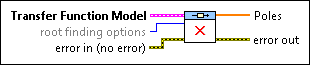
Transfer Function Model contains a mathematical representation of and information about the system for which this VI returns the poles. | ||||||||
 |
root finding options specifies the option for root finding.
|
||||||||
|
error in describes error conditions that occur before this node runs. This input provides standard error in functionality. | ||||||||
|
Poles returns the locations of the model poles. For multiple-input multiple-output (MIMO) system models, this VI calculates the least-common multiple for all the poles of transfer function or zero-pole-gain elements of the MIMO system matrix. These poles are not necessarily identical to the poles you can obtain by using the Smith-McMillan form. | ||||||||
|
error out contains error information. This output provides standard error out functionality. |
CD Poles (Zero-Pole-Gain)

|
Zero-Pole-Gain Model contains a mathematical representation of and information about the system for which this VI returns the poles. |
|
error in describes error conditions that occur before this node runs. This input provides standard error in functionality. |
|
Poles returns the locations of the model poles. For multiple-input multiple-output (MIMO) system models, this VI calculates the least-common multiple for all the poles of transfer function or zero-pole-gain elements of the MIMO system matrix. These poles are not necessarily identical to the poles you can obtain by using the Smith-McMillan form. |
|
error out contains error information. This output provides standard error out functionality. |