CD Convert Continuous Stochastic to Discrete VI
- Updated2023-03-14
- 5 minute(s) read
CD Convert Continuous Stochastic to Discrete VI
Owning Palette: Stochastic Systems VIs
Requires: Control Design and Simulation Module
Converts a continuous stochastic state-space model and the associated continuous noise model to a discrete stochastic state-space model and discrete noise model.

 |
Continuous Stochastic State-Space Model specifies a mathematical representation of a continuous stochastic system. | ||||
|
Continuous Second-Order Statistics Noise Model specifies a continuous mathematical representation of the noise model of the Continuous Stochastic State-Space Model. A noise model defines the expected behavior of the noise vectors w and v. You can use the CD Construct Noise Model VI to construct a noise model for a given stochastic state-space system. | ||||
 |
Sampling Time (s) specifies the discrete sampling time of the Discrete Stochastic State-Space Model. The default value is 1 second. | ||||
 |
Method specifies the method this VI uses to calculate the discrete equivalent of the process noise covariance matrix Q.
|
||||
 |
error in describes error conditions that occur before this node runs. This input provides standard error in functionality. | ||||
 |
Discrete Stochastic State-Space Model returns a mathematical representation of the discrete equivalent of the Continuous Stochastic State-Space Model. | ||||
|
Discrete Second-Order Statistics Noise Model returns a mathematical representation of the discrete equivalent of the Continuous Second-Order Statistics Noise Model. | ||||
 |
error out contains error information. This output provides standard error out functionality. |
CD Convert Continuous Stochastic to Discrete Details
This VI assumes the noise vectors w and v are temporally uncorrelated. This VI also assumes the Sampling Time T you specify is much smaller than the Shannon period of the input signal u(t). Therefore, the following relationship is true:
u(t) ≈ u(kT), kT ≤ t < (k + 1)T
where t is continuous time and k is discrete time.
This VI assumes the Continuous Stochastic State-Space Model is of the following form:

This VI also assumes the Continuous Second-Order Statistics Noise Model is of the following form:
E{w(t)} = mw(t)
E{w(t) · wT(τ)} = Q(t) · δ(t – τ)
E{v(t)} = mv(t)
E{v(t) · vT(τ)} = R(t) · δ(t – τ)
E{w(t) · vT(τ)} = N(t) · δ(t – τ)
where d(t) is the Dirac delta function. This function is defined as d(t) = ∞ when x = 0; d(t) = 0 when x ≠ 0.
This VI returns the Discrete Stochastic State-Space Model in the following form:
x[(k + 1]T] = Adx(kT) + Bdu(kT) + n(kT)
y(kT) = Cdx(kT) + Ddu(kT) + r(kT), k = 0, 1, 2 ...
where
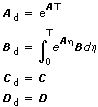
n(kT) and r(kT) are the discrete equivalents of the noise vectors.
This VI returns the Discrete Second-Order Statistics Noise Model in the following form:
E{n(kT)} = [Ad – I]A–1Gmw(kT)
E{n(kT) · nT(lT)} = P(kT)δ(kT – lT), k, l = 0, 1, 2 ...
E{r(kT)} = Hmw + mv(kT)
E{r(kT) · rT(lT)} = S(kT)δ(kT – lT)
E{n(kT) · rT(lT)} = O(kT)δ(kT – lT)
where

If you specify Numerical Integration for the Method parameter, then

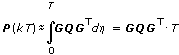
If you specify Truncation of TSE for the Method parameter, then
| where | n is the number of states |
| m is the number of inputs | |
| r is the number of outputs | |
| x is the state vector. | |
| u is the input vector. | |
| y is the output vector. | |
| w is the process noise vector. | |
| v is the observation noise vector. | |
| A is an n × n state matrix of the given system. | |
| B is an n × m input matrix of the given system. | |
| C is an r × n output matrix of the given system. | |
| D is an r × m direct transmission matrix of the given system. | |
| G is a matrix relating w to the states. | |
| H is a matrix relating w to the outputs. | |
| Q is the auto-covariance matrix of w. | |
| R is the auto-covariance matrix of v. | |
| N is the cross-covariance matrix between w and v. | |
| E{} denotes the expected mean or value of the enclosed term(s). |
This approximation becomes less accurate as the value of T increases.