Digital Pattern Generator (Toggle) VI
- Updated2025-07-30
- 3 minute(s) read
Generates a pattern and returns the pattern as a digital waveform. Depending on the instance you use, the VI can return a ramp, marching values, single value, random, or toggle pattern as a waveform. You must manually select the polymorphic instance you want to use.
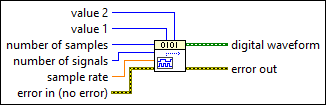
Inputs/Outputs
 value 2
—
value 2
—
value 2 is the second digital bit state of the generated digital waveform. The default is 1.
value 1
—
value 1 is the first digital bit state of the generated digital waveform. The default is 0.  number of samples
—
number of samples
—
number of samples specifies the number of samples to include in the generated digital waveform.
number of signals
—
number of signals specifies the number of signals to include in the generated digital waveform.  sample rate
—
sample rate
—
sample rate specifies the sample rate of the generated digital waveform. The default is 1 kHz.  error in (no error)
—
error in (no error)
—
error in describes error conditions that occur before this node runs. This input provides standard error in functionality.  digital waveform
—
digital waveform
—
digital waveform returns the generated digital waveform pattern.  error out
—
error out
—
error out contains error information. This output provides standard error out functionality. |
The Ramp instance generates a digital waveform that contains a binary count-up pattern that starts at zero and counts up by one until it reaches 2n–1, where n = number of signals.