Complex To Polar Function
- Updated2026-02-04
- 2 minute(s) read
Breaks a complex number into its polar components.
The connector pane displays the default data types for this polymorphic function.
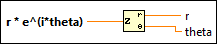
Inputs/Outputs
 r * e^(i*theta)
—
r * e^(i*theta)
—
r * e^(i*theta) can be a complex number, a cluster of complex numbers, an array of complex numbers, an array of clusters of complex numbers, and so on.  r
—
r
—
r is of the same data type structure as r * e^(i*theta), with scalar representation instead of complex.
theta
—
theta is of the same data type structure as r * e^(i*theta), with scalar representation instead of complex. theta is in radians. |
Given z in rectangular form z = a + bi, this function converts the polar components of z = r * e^(i*theta) according to the following equations:
r = |z| = sqrt(a² + b²) theta = arg(z) = arctan2(b,a)When you wire matrix data as an input to this function, a VI that includes subVIs that work with the matrix data type replaces the function. The resulting VI has the same icon but contains a matrix-specific algorithm. The node remains a VI if you disconnect the matrix from the input(s). Wire other data types as inputs to restore the original function. If you wire a data type to a function and that data type causes a basic math operation to fail, the function returns an empty matrix or NaN.