Waveform Scalar Limit Comparison
- Updated2023-02-17
- 4 minute(s) read
Waveform Scalar Limit Comparison
Compares the waveform data values to a scalar value.
Inputs/Outputs

waveform
The waveform that includes the data you want to compare to a specified limit.

compare condition
The comparison operation you want to use to compare the waveform data value to the scalar value.
| < | 0 | The highest or lowest value in the waveform is less than the limit. |
| <= | 1 | The highest or lowest value in the waveform is less than or equal to the limit. |
| > | 2 | The highest or lowest value in the waveform is greater than the limit. |
| >= | 3 | The highest or lowest value in the waveform is greater than or equal to the limit. |
Default value: 3

limit
Number to which you want to compare the highest or lowest data value in the waveform.
Default value: 5

error in
Error conditions that occur before this node runs.
The node responds to this input according to standard error behavior.
Default value: No error
Standard Error Behavior
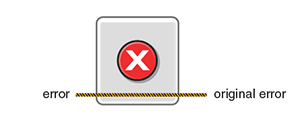
Many nodes provide an error in input and an error out output so that the node can respond to and communicate errors that occur while code is running. The value of error in specifies whether an error occurred before the node runs. Most nodes respond to values of error in in a standard, predictable way.
| error in does not contain an error | error in contains an error |
|---|---|

|
|
| If no error occurred before the node runs, the node begins execution normally.
If no error occurs while the node runs, it returns no error. If an error does occur while the node runs, it returns that error information as error out. |
If an error occurred before the node runs, the node does not execute. Instead, it returns the error in value as error out. |

waveform and result
Two waveforms in an array.

passed?
A Boolean value indicating whether the highest or lowest data value meets the compare condition based on the limit.
| True | The highest or lowest data value meets the comparison. |
| False | The highest or lowest data value does not meet the comparison. |

error out
Error information.
The node produces this output according to standard error behavior.
Standard Error Behavior
Many nodes provide an error in input and an error out output so that the node can respond to and communicate errors that occur while code is running. The value of error in specifies whether an error occurred before the node runs. Most nodes respond to values of error in in a standard, predictable way.
| error in does not contain an error | error in contains an error |
|---|---|
|
|
|
| If no error occurred before the node runs, the node begins execution normally.
If no error occurs while the node runs, it returns no error. If an error does occur while the node runs, it returns that error information as error out. |
If an error occurred before the node runs, the node does not execute. Instead, it returns the error in value as error out. |