Managing Critical Substances
NI is committed to producing environmentally friendly products and complies with all applicable environmental and supply chain responsibility laws.
EU RoHS Compliance
The EU Directive on Restriction of the Use of Certain Hazardous Substances (RoHS) (2011/65/EU) restricts the use of harmful substances such as lead, mercury, and cadmium in products. It applies to 11 categories of electrical and electronic equipment. NI products fall under Industrial Monitoring and Control Instruments within Category 9, which came into scope July 22, 2017. NI fully complies with the RoHS directive.
The Directive (2015/863/EU) amended Annex II to the EU RoHS Directive (2011/65/EU) to add four phthalates on the list of restricted substances. This requires that each homogeneous substance in a part contain a maximum concentration level of less than 0.1 percent by weight of bis(2-ethylhexyl) phthalate (DEHP), benzyl butyl phthalate (BBP), dibutyl phthalate (DBP), and diisobutyl phthalate (DIBP).
NI surveyed our supply chain to determine the presence of the four new substances in our products. Most of NI's products were certified as compliant with the RoHS Directive (EU) 2015/863 before the July 22, 2021 deadline for Category 9, Industrial Monitoring and Control Instruments. Download the Declaration of Conformity for your product by searching for the model number at the NI Product Certifications site..
Challenges
In addition to the far-reaching impact on the supply chain, NI faces the following challenges in the process of eliminating hazardous substances from its products:
- Organizations such as the Environmental Protection Agency (EPA) have found that the replacement options for certain hazardous substances may have an environmental impact equal to or worse than the original hazardous substance. To mitigate this issue, NI is actively involved with numerous trade organizations around the world. Through involvement with these organizations and close relationships with suppliers, NI stays at the forefront of both advanced technological developments in materials and compliance with worldwide regulations of hazardous substances.
- Regulations in this area evolve rapidly. NI is a member of the Test and Measurement Coalition and works through this organization to refine legislation.
View the full text of the RoHS Directive. For more information about NI compliance with RoHS, contact rohs@ni.com.
China RoHS
On January 16, 2016, the Chinese Ministry of Information Industry promulgated China's requirements for the "Management Methods for Restriction of the Use of Hazardous Substances in Electronic and Electrical Products." These requirements spell out Chinese policy on the Restriction of Hazardous Substances (RoHS) used in Electronic and Electrical Products (EEPs).
The Chinese "Management Methods" are similar to European Union RoHS requirements because they recognize the same six hazardous substances and the same maximum concentration levels. The "Management Methods" regulation also defines requirements for product labeling and hazardous substance level disclosure. The following industry standards were developed to describe the requirements:
- Labeling - SJ/T11364-2014 "Marking for the Restricted Use of Hazardous Substances in Electronic and Electrical Products"
- Maximum concentration levels - GB/T 26572-2011 "Requirements for Concentration Limits for Certain Hazardous Substances in Electronic and Electrical Products"
National Instruments meets the "Management Methods" requirements by providing appropriate labeling and hazardous substance disclosure with all products that fall under the EEP definition.
Disclosure of Hazardous Substances and Elements
SJ/T 11364-2014 requires that all EEP manufacturers supply a table disclosing toxic or hazardous substances contained in a product. Table 1 is an example of the information supplied with NI EEP products.
The table discloses hazardous substance concentration values above or below the limit requirements defined in GB/T 26572-2011. An "X" or "O" in the table row identifies whether a hazardous substance is present for each major component of the product.
Table 1. Example Toxic or Hazardous Substances and Elements Contained in Product
| Component Name | Toxic or Hazardous Substances and Elements | |||||
|---|---|---|---|---|---|---|
| Lead (Pb) | Mercury (Hg) | Cadmium (Cd) | Hexavalent chromium (Cr6+) | Polybromin- ated biphenyls (PBB) | Polybromin- ated diphenyl ethers (PBDE) | |
| Printed circuit card assembly | X | O | O | O | O | O |
| Metal enclosure | X | O | O | X | O | O |
O: Indicates that the toxic or hazardous substance contained in all of the homogeneous materials for this part is below the limit required in in GB/T 26572-2011.
X: Indicates that the toxic or hazardous substance contained in at least one of the homogeneous materials used for this part is above the limit requirement in GB/T 26572-2011.
Product Marking Explanations
In accordance with the requirements specified in SJ/T 11364-2014, all NI EEPs sold in the People's Republic of China are marked with pollution control logos.
The following illustrations show the markings that apply to NI products.

Logo 1 - No part of the EEP contains toxic or hazardous substances or elements above the requirements listed in GB/T 26572-2011.
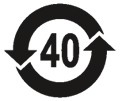
Logo 2 - Some homogenous substance within the EEP contains toxic or hazardous substances or elements above the requirements listed in GB/T 26572-2011. These substances are identified in Table 1.
The size or function of some products may prevent them from being directly marked. These products still meet the requirements of GB/T 26572-2011, and their marking information is covered in the Hazardous Substance Disclosure form that is shipped with the EEP.
Environmentally Friendly Use Period
The number in Logo 2, shown as 40 in the illustration, refers to an EEP's environmentally friendly use period (EFUP). The EFUP is the number of years from the date of manufacture that toxic or hazardous substances or elements contained in EIPs will not leak or mutate under normal operating conditions resulting in any environmental pollution, bodily injury, or damage to assets.
Manufacture Date
Manufacture dates of all National Instruments products are encoded into the product serial number. Contact your local sales office to obtain the manufacture date for your product.
Hazardous Substance Disclosure Statements
Taiwan RoHS
On July 30, 2013, Taiwan Bureau of Standards, Metrology and Inspection (BSMI), Ministry of Economic Affairs MOEA promulgated Taiwan's requirements for the "CNS15663 Guidance to reduction of the restricted chemical substances in electrical and electronic equipment." These requirements spell out Taiwanese policy on the Restriction of Hazardous Substances (RoHS) used in electronic and electrical equipment.
Taiwan "restricted chemical substances" are similar to European Union RoHS requirements because they recognize the same six hazardous substances and the same maximum concentration levels. The "restricted chemical substances" regulation also defines requirements for product labeling and hazardous substance level disclosure. The following industry standards were developed to describe the requirements:
- Labeling - CNS 15663 Section 5 "Marking Presence” requires to clearly mark “the presence conditions of the restricted substances”
National Instruments meets the requirements by providing appropriate labeling and hazardous substance disclosure with all products that fall under the BSMI electrical equipment definition.
Disclosure of Restricted Chemical Substances
CNS 15663 Section 5 requires that all manufacturers supply a table disclosing restricted substances contained in a product. Table 1 is an example of the information supplied with BSMI certified products.
The table discloses restricted substance concentration values above or below the limit requirements defined in CNS15663 Section 5. An "-" or "O" in the table row identifies whether a hazardous substance is present for each major component of the product.
Table 1. Example of marking for the content of restrict substance other than exemption not exceeding the reference percentage value of presence condition.
| Unit | Restricted Substances and its Chemical Symbol | |||||
|---|---|---|---|---|---|---|
| Lead (Pb) | Mercury (Hg) | Cadmium (Cd) | Hexavalent chromium (Cr6+) | Polybromin- ated biphenyls (PBB) | Polybromin- ated diphenyl ethers (PBDE) | |
| Printed circuit card assembly | O | O | O | O | O | O |
| Metal enclosure | – | O | – | – | O | O |
O: Indicates that the percentage content of the restricted substance does not exceed the percentage of reference.
–: Indicates that the restricted substance corresponds to the exemption.
Product Marking Explanations
In accordance with the requirements specified in Section 5 "Marking of presence" of CNS 15663 all certified products clearly mark "the presence condition of the restricted substances".
The following illustration shows the markings that apply to NI products.
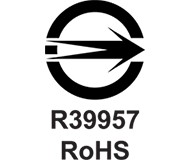
The mark now includes “RoHS”. The “RoHS” of the identification number indicates that “the content of restricted substance(s) other than exemption” of the products, does not exceed the reference percentage value.
Download myRIO-1900 and myRIO-1950 Chinese User Manual/下載myRIO-1900 及myRIO-1950中文手冊
Product RoHS tables
Taiwan RoHS Table for cRIO-9805
YP-12 + YC-20D1 (125V 15A 2P+E C15)
YP-16C+YC-18(250V 15A 2P+E C19)
Manufacture Date / 製造日期
Manufacture dates of all National Instruments products are encoded into the product serial number. Contact your local sales office to obtain the manufacture date for your product.
所有產品的製造日期可從序號中查詢。請與您當地的銷售辦事處聯繫以獲得產品的製造日期,或到以下網站輸入產品序號查詢製造日期。 查詢產品製造日期: https://sine.ni.com/apps/utf8/nical.main
REACH (Registration, Evaluation, Authorization, and Restriction of Chemicals)
In 2006, the European Parliament and the Council adopted Regulation (EC) No 1907/2006 on the Registration, Evaluation, Authorization, and Restriction of Chemicals (REACH). One of the regulation’s primary objectives is to protect the environment from harmful substances.
Goals of REACH
Under REACH, manufacturers and importers of chemicals are required to register this information in a central database. REACH also gives responsibility to industry to manage the risks from chemicals and to provide users in the supply chain with safety information on the substances.
Producers of articles must notify customers of all Substances of Very High Concern (SVHC) contained in volumes >1 tonne/year, in concentrations above 0.1 percent of the product weight, and from which exposure cannot be excluded. Under REACH, companies using targeted chemicals in any product will have to ask for a specific authorization and provide justification for using the substance. The identification of a substance as a SVHC and its inclusion in the Candidate List can trigger certain legal obligations for the importers, producers, and suppliers of an article that contains such a substance.
NI’s Position and Obligations
Please find our latest REACH Regulation Statement here.
As a global manufacturer and supplier, NI constantly reviews existing and upcoming international legislation. NI also stays abreast of global requirements through memberships and involvement in recognized organizations such as EPPA and standards bodies such as IEC.
As a test and measurement equipment manufacturer in the EU, NI does not produce or import chemical substances in excess of 1 tonne/year. Any materials purchased for use in our EU manufacturing facilities, such as solder, are purchased within the EU and comply with current registration requirements. In addition, NI products do not release any substances into the environment during normal and foreseeable conditions of use.
All NI products including accessories and packaging are considered “articles” under REACH. NI confirms, based on information gathered through the supply chain, that its electronic instrument products contain none of the substances identified as SVHC, above a concentration of 0.1 percent by weight of product, other than those on the NI SVHC Product Listing. NI regularly reviews the Candidate List published by ECHA and responds to any SVHCs found in NI products. In addition, NI receives information from the supply chain and will provide updated information to customers of any changes required for continued safe use of products. In support of REACH goals, NI provides appropriate substance use information to its material vendors. Suppliers of an article must, under certain conditions, communicate information down the supply chain. This information can help our vendors in correctly recording our substance use case in the event they are required to register per REACH requirements.
For specific product information related to REACH, contact reach@ni.com.
Conflict Minerals Trade Act
In 2010, the United States enacted Section 1502 of the Dodd-Frank Wall Street Reform and Consumer Protection Act to address humanitarian concerns in the Democratic Republic of the Congo (DRC). The concerns stem from four minerals obtained from rebel-controlled mines in the DRC region: gold, tantalum, tin, and tungsten. The law and subsequent rules published by the US Securities and Exchange Commission (SEC) require publicly traded companies to disclose the following information starting for fiscal year 2013:
- Which products require the four minerals for functionality or manufacturing
- The presence of any of the four minerals that originate from conflict sources
- The efforts taken to determine the origin of the minerals used in products
NI has a responsible sourcing policy to avoid purchasing components that contain minerals obtained from conflict sources. Moving forward, NI will assess all its new suppliers for their ability to provide reliable data regarding the country of origin for conflict minerals. In the event that minerals from conflict sources are found in the NI supply chain, appropriate actions will be taken in a timely manner to resolve the situation. NI expects its suppliers to react in a similar way and has communicated this policy to all suppliers.
For additional information on NI compliance with the Conflict Minerals Trade Act, contact conflictminerals@ni.com. Download the latest version of the Conflict Minerals Reporting Template (CMRT).