Interactive Analysis in DIAdem
|

Larger Picture
|
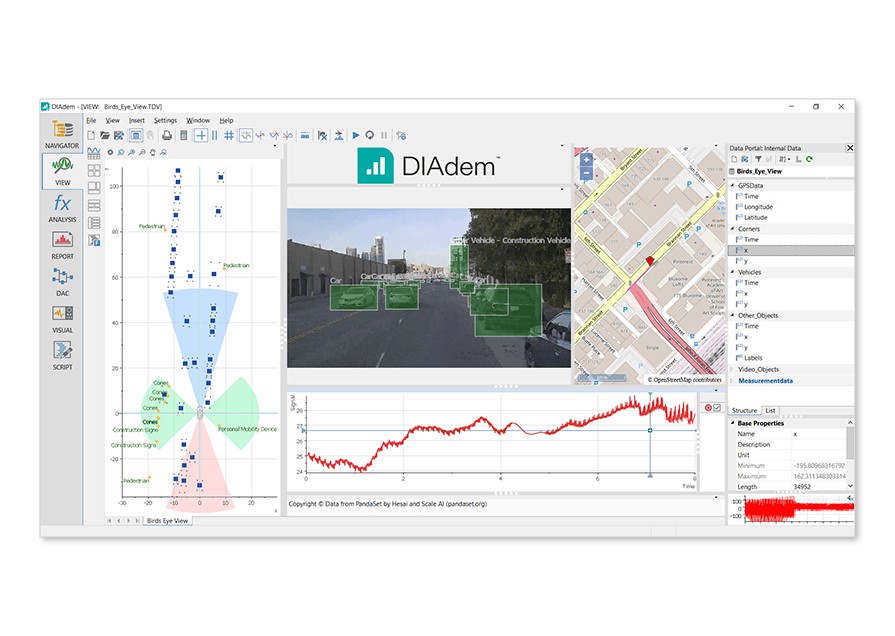
National Instruments DIAdem is an interactive, ready-to-run software tool for mathematical and visual data analysis, report generation, task automation and data management. DIAdem requires no programming or scripting to analyze your data.
The concept of DIAdem is based on grouping like functions onto icons and making related functions available easily. The functions have been grouped into five major areas: data management, graphical analysis, mathematical analysis, report generation and integrated script capabilities.
|
|
Data Analysis
Data analysis is an important step in getting to your results; analysis provides additional intelligence that allows you to make informed decisions based on your data. DIAdem offers a wide range of powerful mathematical routines to analyze your data with. The DIAdem analysis libraries are separated into groups of like functionality. Each analysis function has its own unique set of parameters that are specific to the individual analysis function. The DIAdem analysis functions are completely mouse driven and require no additional scripting to analyze your data. There also is a powerful formula interpreter that allows you to enter your own math functions interactively.
Once a function has been selected by clicking on its icon, a dialog will appear that shows all available settings for the particular functions. You simply select the function and the parameters and execute the calculation, no programming required.
|

Larger Picture
|
Visual Analysis
In addition to mathematical analysis, DIAdem provides visual analysis functions. The DIAdem visual analysis functions include several different cursor options for zooming, and scrolling, as well as features for truncating, copying ranges of data, and marking specific points. You can also define and incorporate your own visual analysis functions. The visual analysis functions are completely mouse driven providing a truly interactive environment for visually inspecting and analyzing your data.
|

Larger Picture
|
Complete List of built in functions
Basic mathematics
- Summation, differentiation, integration, norming, relativization
- Floating RMS
- Peaks search (Minima/Maxima) function
- Data sorting
- Average of multiple data channels
- Generation of data channels
- NoValues (gaps in measurements)
- Formula calculator
Curve fitting
- Running average calculation
- Regressions
- Multi-polynomial curve fits
- Splines
- Akima splines
- Data re-sampling
- Circle approximation
- Envelope curve calculation
Statistics
- Basic statistics:
Minimum, maximum, range, sum of measured values and measured value squares, coefficient of variation, quartiles, central value (0.5 quantile), averages, mean and median, quartile interval, standard deviation, variance, skewness, kurtosis
- Advanced statistics:
Classifications: Random sample, time at level counting, level crossing counting, max. value saving procedure, range counting, range pair counting, peak value counting
- Rainflow analysis:
Classifications: Random sample, time at level counting, level crossing counting, max. value saving procedure, range counting, range pair counting, peak value counting
Signal processing
- Fourier analysis (FFT)
- Real/imaginary part
- Phase
- Peak amplitude
- RMS amplitude
- RMS2 amplitude
- Auto power spectrum
- Power spectrum density
- Octave and third octave analysis
- inverse FTT
- Digital filter design
- Auto correlation
- Cross correlation
- Order Analysis
3D mathematics
- Matrix 1 triplet conversion
- Generation of a partial matrix
- Matrix sorting, transposition
- Append a matrix
- Matrix relativization, norming, extreme values
- Surface integral
- Sum the matrix elements calculation
- Matrix-matrix, matrix-vector, matrix-scalar operations
- Contour calculation
- Surface approximation
- Surface interpolation
Crash analysis
- Standardized CFC and FIR filters
- Acomp calculation (Acceleration during compression phase)
- FFC calculation (Femur Force Criterion)
- HCD calculation (Head Contact Duration)
- HIC calculation (Head Injury Criterion)
- HPC calculation (Head Performance Criterion)
- SI value calculation (Severity Index) for chest and rib areas
- TI calculation (Tibia Index)
- TTI calculation (Thorax Trauma Index)
- VC calculation (Viscous Criterion)
- NIC and NIJ calculation (Neck Injury Criterion)
- NIC rear impact calculation
- X ms value: maximum acceleration value of X milliseconds
- Xg value: total time that the acceleration signal was = X[g]
- Calculation of pulse limits
- Calculation of pulse duration
|
|