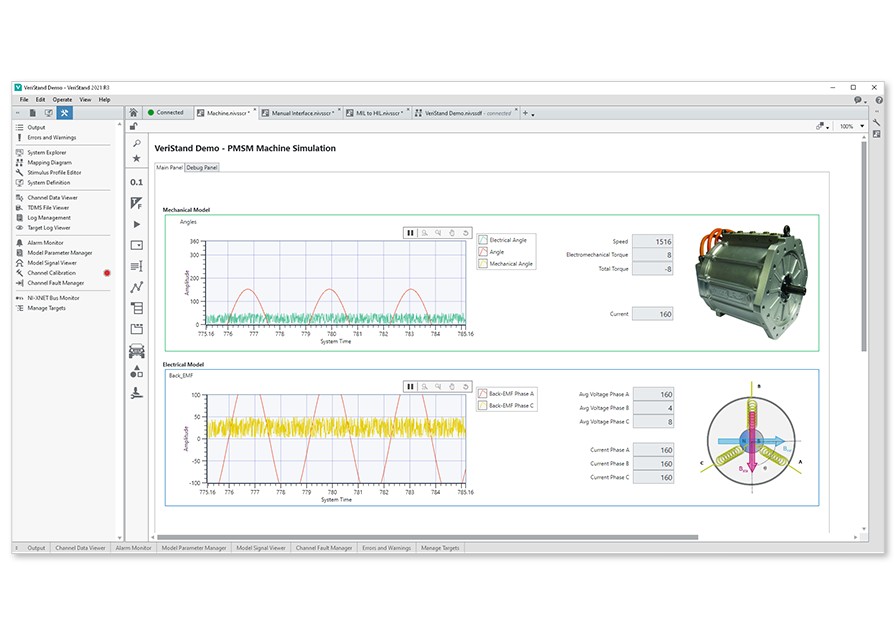
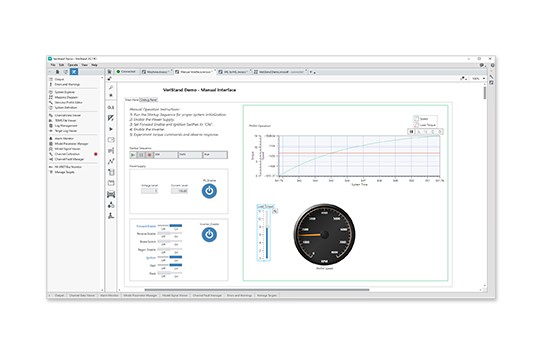
NI VeriStand is a software environment for configuring real-time testing applications. Out of the box, NI VeriStand helps you configure a multicore-ready real-time engine to execute tasks that include the following:
NI VeriStand can also import control algorithms, simulation models, and other tasks from NI LabVIEW software and third-party environments. You can monitor and interact with these tasks using a run-time editable user interface that includes many useful tools for value forcing, alarm monitoring, I/O calibration, and stimulus profile editing. Although no programming knowledge is required to use NI VeriStand, you can customize and extend it using a variety of software environments such as LabVIEW, ANSI C/C++, and others for modeling and programming.
Explore the resources below or watch the demo videos.
Real-time testing involves using a real-time OS as part of a test system. The most common requirements driving the need for a real-time test system are to achieve greater reliability and performance than is possible using a general-purpose OS. NI VeriStand is designed to run on NI real-time hardware for configuring real-time testing applications.
The NI VeriStand Engine is the execution mechanism that controls the timing of the entire system as well as the communication between the execution host and the user interface. The framework is preconstructed, so timing and communication are transparent, making real-time testing applications easier to create.
You can use NI VeriStand with NI data acquisition (DAQ) hardware, FPGA modules such as NI R Series DAQ, NI CompactRIO, and NI FlexRIO, as well as NI-XNET hardware for automotive networks such as CAN, LIN, and FlexRay. In addition to National Instruments hardware, NI VeriStand natively supports GE Reflective Memory Modules for distributed real-time testing.
A common requirement of many real-time test systems is the ability to simulate system components. NI VeriStand can import simulation models from a variety of modeling environments including SimulationX from ITI, LabVIEW, and The Mathworks, Inc. Simulink® software. NI VeriStand can also import compiled code from programming languages such as ANSI C, C++, and Fortran.
Although NI VeriStand provides most of the functionality required by a real-time testing application, it can be customized and extended using LabVIEW and other software environments to ensure it always meets specific application requirements.
A key component of a real-time testing application is the ability to create specific test scenarios. This is achieved by using test profiles that provide stimuli representing both control signals and load conditions to the device under test. NI VeriStand features an advanced stimulus profile editor that ensures accurate representation of any real-world condition.
You can use NI VeriStand to configure reflective memory networks and timing interfaces to create applications with multiple, synchronized real-time execution targets.
Simulink® is a registered trademark of The MathWorks, Inc.