


Academic Company Events NI Developer Zone Support Solutions Products & Services Contact NI MyNI

NI CompactRIO Control and Acquisition System

  • Small, rugged embedded control and data acquisition system
  • Powered by National Instruments LabVIEW graphical programming tools for rapid development
  • Features embedded real-time processor for reliable stand-alone or distributed operation
  • Integrates an embedded FPGA chip that provides the flexibility, performance, and reliability of custom hardware
  • Includes hot-swappable industrial I/O modules with built-in signal conditioning for direct connection to a variety of sensors and actuators
  • Features extreme industrial certifications and ratings:
    • -40 to 70 °C (-40 to 158 °F) operating temperature
    • Up to 2,300 Vrms isolation (withstand)
    • 50 g shock rating
    • International safety, EMC, and environmental certifications
    • Class I, Division 2 rating for hazardous locations
    • Dual 9 to 35 VDC supply inputs, low power consumption (7 to 10 W typical)

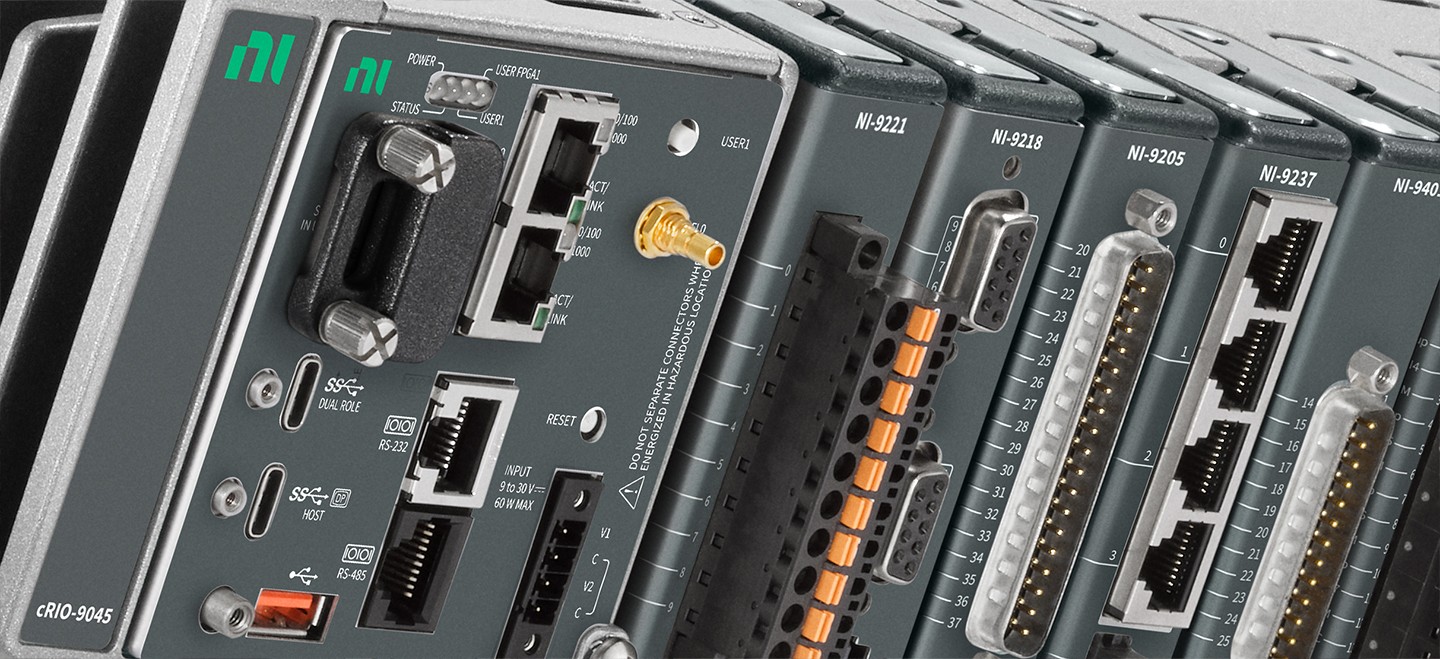
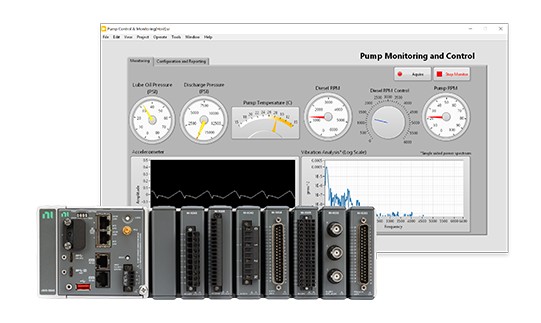
The National Instruments CompactRIO programmable automation controller is an advanced embedded control and data acquisition system designed for applications that require high performance and reliability. With the system's open, embedded architecture, small size, extreme ruggedness, and flexibility, engineers and embedded developers can use COTS hardware to quickly build custom embedded systems. NI CompactRIO is powered by National Instruments LabVIEW FPGA and LabVIEW Real-Time technologies, giving engineers the ability to design, program, and customize the CompactRIO embedded system with easy-to-use graphical programming tools.

CompactRIO combines an embedded real-time processor, a high-performance FPGA, and hot-swappable I/O modules. Each I/O module is connected directly to the FPGA, providing low-level customization of timing and I/O signal processing. The FPGA is connected to the embedded real-time processor via a high-speed PCI bus. This represents a low-cost architecture with open access to low-level hardware resources. LabVIEW contains built-in data transfer mechanisms to pass data from the I/O modules to the FPGA and also from the FPGA to the embedded processor for real-time analysis, postprocessing, data logging, or communication to a networked host computer.

C Series I/O Modules

A variety of I/O types are available including voltage, current, thermocouple, RTD, accelerometer, and strain gauge inputs; up to ±60 V simultaneous-sampling analog I/O; 12, 24, and 48 V industrial digital I/O; 5 V/TTL digital I/O; counter/timers; pulse generation; and high voltage/current relays. Because the modules contain built-in signal conditioning for extended voltage ranges or industrial signal types, you can usually connect wires directly from the C Series modules to your sensors and actuators.

FPGA

The embedded FPGA is a high-performance, reconfigurable chip that engineers can program with LabVIEW FPGA tools. Traditionally, FPGA designers were forced to learn and use complex design languages such as VHDL to program FPGAs. Now, any engineer or scientist can use graphical LabVIEW tools to program and customize FPGAs. Using the FPGA hardware embedded in CompactRIO, you can implement custom timing, triggering, synchronization, control, and signal processing for your analog and digital I/O.

Real-Time Processor

The CompactRIO embedded system features an industrial 400 MHz Freescale MPC5200 processor that deterministically executes your LabVIEW Real-Time applications on the reliable Wind River VxWorks real-time operating system. LabVIEW has built-in functions for transferring data between the FPGA and the real-time processor within the CompactRIO embedded system. Choose from more than 600 built-in LabVIEW functions to build your multithreaded embedded system for real-time control, analysis, data logging, and communication. You can also integrate existing C/C++ code with LabVIEW Real-Time code to save on development time.

Size and Weight

Size, weight, and I/O channel density are critical design requirements in many embedded applications. A four-slot reconfigurable embedded system measures 179.6 by 88.1 by 88.1 mm (7.07 by 3.47 by 3.47 in.) and weighs just 1.58 kg (3.47 lb).

Application Examples

With the low cost and reliability of CompactRIO, as well as its suitability for high-volume embedded measurement and control applications, you can adapt it to solve a wide variety of industry and application challenges. Examples include:

  • In-vehicle data acquisition, data logging, and control
  • Machine condition monitoring and protection
  • Embedded system prototyping
  • Remote and distributed monitoring
  • Embedded data logging
  • Custom multiaxis motion control
  • Electrical power monitoring and power electronics control
  • Servo-hydraulic and heavy machinery control
  • Batch and discrete control
  • Mobile/portable noise, vibration, and harshness (NVH) analysis

The CompactRIO platform is available in three configurations:

CompactRIO Reconfigurable Embedded System
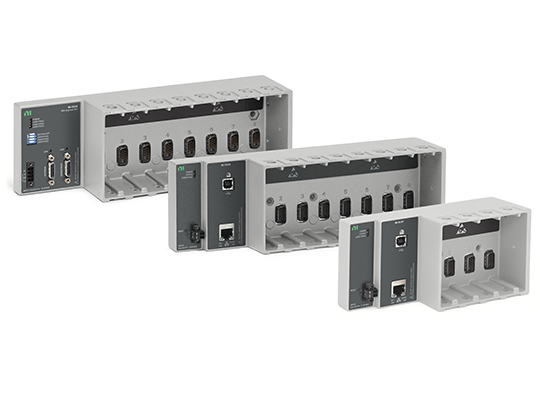
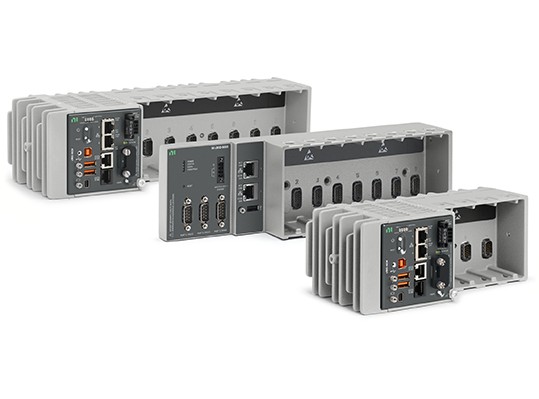
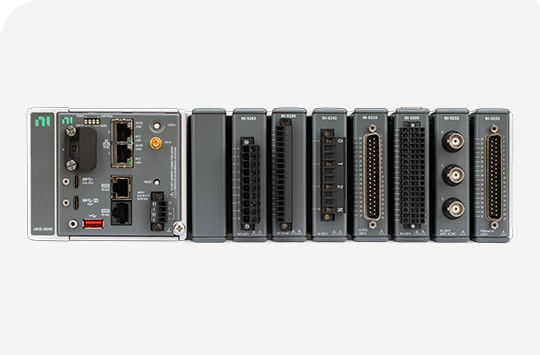
In this configuration, CompactRIO is a complete, reconfigurable embedded system for rugged stand-alone or networked control and data acquisition applications. The embedded system consists of a real-time embedded controller, a reconfigurable chassis containing the user-programmable FPGA, and a variety of hot-swappable industrial I/O modules.

The reconfigurable embedded system comes in two configurations: modular, and integrated. In the modular configuration, the embedded controller chassis containing the FPGA are sold separately. The modular configuration provides the most flexibility in system configuration and performance selection. The integrated configuration combines the controller and chassis containing the FPGA in a single unit. This configuration provides a high level of system performance and is ideal for high volume applications.

CompactRIO R Series Expansion System
In this configuration, a CompactRIO expansion chassis connects to the digital port on a PCI or PXI R Series FPGA-based intelligent DAQ device. You can install the R Series device in any desktop PC, single-board computer, or PXI system running Windows or LabVIEW Real-Time. The FPGA resides on the R Series device, and the cRIO-9151 expansion chassis and C Series I/O modules add high-performance signal conditioning and isolation to the R Series device.

CompactRIO Remote High-Speed Interface System
In this configuration, the National Instruments cRIO-9052 high-speed remote controller replaces a CompactRIO real-time controller to provide a high-speed interface between any NI cRIO-910x reconfigurable FPGA chassis and a laptop, PXI system, or PC. With the NI cRIO-9052, engineers can interface to the FPGA inside of a CompactRIO chassis at rates up to 50 MB/s. The result is a remote, reconfigurable solution ideal for applications requiring the flexibility of an FPGA and a high-speed interface to a laptop or PC. You can choose to interface the CompactRIO high-speed remote system to a LabVIEW Windows application running on a laptop, PC, or PXI system or to a LabVIEW Real-Time application running on a PC or PXI system.

Additional Resources: