Kongsberg Maritime Expands Subsea System Visibility
Case Study Highlights
- Kongsberg Maritime integrated subsea devices and sensors into a single monitoring platform that improves operational visibility.
- NI CompactRIO enabled support for diverse communication protocols and instrumentation without redesigning the system architecture.
- The modular platform allows future expansion while maintaining the reliability required for hard-to-reach subsea deployments.

“The Kongsberg Maritime K-SEM has been a tremendous success for us and is now the basis for all our Riser Management System deliveries where BOP stack instrumentation is required. The combination of NI CompactRIO hardware and Viewpoint Systems services have absolutely been part of this success.”
—Lasse Eilertsen, Principal Engineer, Kongsberg Maritime
The Challenge
Kongsberg Maritime needed a reliable subsea communications hub that could aggregate data from blowout preventer systems, riser equipment, and third-party devices. The system had to operate in a harsh offshore environment, support multiple communication protocols and sensor types, and provide a scalable architecture capable of adapting to changing customer requirements while minimizing costly subsea maintenance.
The Solution
Kongsberg Maritime selected CompactRIO as the core of its Subsea Electronic Module (K-SEM). Working with Viewpoint Systems, the team developed an NI LabVIEW Real-Time application that collects data from sensors and intelligent devices, supports multiple protocols including Modbus, CAN, and OPC UA, and delivers monitoring data to topside systems through a flexible and expandable architecture.
Kongsberg Maritime is a leader in technologies that support safe and efficient subsea oil and gas operations. As part of its riser management system (RMS) strategy, the company identified a growing need to provide operators with greater visibility into the condition and behavior of critical subsea equipment.
The company envisioned a subsea electronic module (K-SEM) capable of serving as a centralized communications hub for monitoring key assets including blowout preventers (BOPs), lower marine riser package (LMRP) components, motion reference units (MRUs), power systems, and intelligent third-party devices.
Existing offshore operations increasingly rely on data from distributed sensors and digital assets. However, integrating these systems can be challenging because different vendors use different protocols, communication methods, and instrumentation technologies. Kongsberg Maritime needed a platform capable of unifying these diverse technologies into a single monitoring architecture.
Just as importantly, the system needed to be highly reliable. Maintenance and service operations on subsea equipment are costly and time-consuming. Any solution deployed underwater must operate dependably for extended periods while continuing to support evolving operational requirements.
Building a Flexible Subsea Communications Hub
Kongsberg Maritime defined the overall system architecture, requirements, and functional objectives for the K-SEM platform. After evaluating controller options, the company selected NI CompactRIO as the foundation of the communications and data acquisition system.
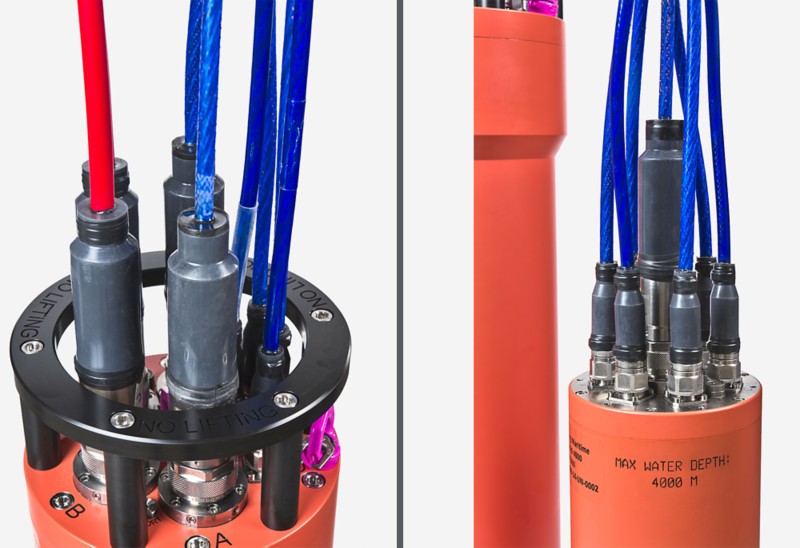
The resulting K-SEM combines CompactRIO with custom power supplies, Ethernet routing, DSL communications, serial interfaces, and analog connectivity. CompactRIO serves as the data aggregation and communications engine that connects multiple subsea devices and delivers operational information to topside monitoring systems.
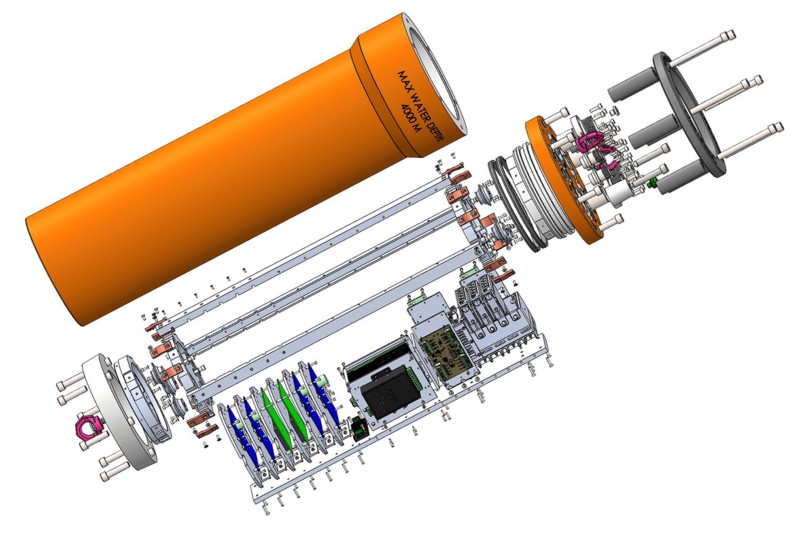
The flexibility of the CompactRIO platform allows support for a broad range of communications technologies including Modbus, CAN, OPC UA, and custom protocols implemented using FPGA technology. The system can also integrate analog signals from strain gauges, LVDTs, pressure transmitters, temperature transmitters, and other industrial instrumentation.
Because the CompactRIO modular architecture supports interchangeable C Series modules, the configuration can be adapted to meet changing customer and project requirements without redesigning the core platform.
Collaborating Across Continents
To accelerate development, Kongsberg Maritime partnered with Viewpoint Systems, a systems integration NI Partner with extensive experience developing applications using NI CompactRIO and LabVIEW Real-Time technology.
Working from the United States and Norway, the teams collaborated closely throughout development, testing, and deployment. Development activities included requirements reviews, software implementation, remote debugging sessions, and formal acceptance testing before each release.

The development process followed incremental implementation cycles that enabled new functionality to be added in a controlled manner while minimizing project risk. This approach allowed the K-SEM platform to grow steadily in capability while maintaining confidence in system performance and reliability.
Remote collaboration tools supported efficient debugging and validation activities. Engineers verified Modbus communications, validated OPC UA outputs, and performed comprehensive acceptance testing before deployment into the field.
Delivering Greater Operational Visibility
After the CompactRIO system and the rest of the K-SEM elements were validated, Kongsberg had a powerful solution which serves as a centralized subsea data hub to connect intelligent devices, instrumentation, and sensors with topside monitoring systems.
Devices commonly connected to the platform include MRUs, power systems, LVDT sensors, cameras, distributed Kongsberg equipment, and third-party devices communicating through serial, Ethernet, DSL, and Modbus interfaces.
The ability to aggregate, normalize, and transmit information from disparate systems gives operators greater visibility into the behavior of critical subsea assets. This increased awareness supports more informed operational decisions and improves understanding of riser and blowout preventer performance. This visibility lets the rig operators do condition-based, predictive maintenance to extend the life of a well. Doing even 10 maintenance events is often less expensive than drilling a new well.
The NI Advantage
The combination of NI CompactRIO and LabVIEW provided Kongsberg Maritime with a proven foundation for developing a robust subsea communications platform. The system’s modular architecture supports future expansion while maintaining the reliability required for deployment in difficult-to-access offshore environments.
By leveraging CompactRIO communication capabilities, flexible I/O options, and support for industry-standard protocols, Kongsberg Maritime successfully created a scalable monitoring platform that enhances visibility into critical subsea operations and provides a foundation for future innovation.
An NI Partner is a business entity independent from NI and has no agency or joint-venture relationship and does not form part of any business associations with NI.