ni.com is currently undergoing scheduled maintenance.
Some services may be unavailable at this time. Please contact us for help or try again later.

Access as the Blueprint for Engineering Education
CUSTOMER STORY
6 MINUTE READ
How do you teach hands-on engineering from anywhere? UAH is expanding access with flexible learning, portable labs, and practical AI education.
AUTHOR: Dr. Alisa Henrie, Department Chair of Engineering Technology, The University of Alabama in Huntsville
For many engineering students, the degree is not the only thing competing for their attention. They may be working full time, supporting a family, serving in the military, or returning to school after finances, health, or other situation interrupted their education. Their path rarely fits the traditional model of living near campus and attending class by day, though their goal is the same as every engineering student’s: to build the knowledge and confidence to solve real problems.
At the University of Alabama in Huntsville, that reality has shaped an engineering technology program built around access. Classes run in the evening and can be completed on campus or online, often through synchronous instruction that brings remote students directly into the room.
For Dr. Alisa Henrie, flexibility is more than a delivery model. It’s what keeps engineering within reach for students weighing work, school, and money: some hit a roadblock years into a degree, others need to stay employed while they finish, and military students could be transferred or deployed mid-semester.
A flexible schedule gives them a way forward, but engineering technology is a discipline of implementation. Flexibility alone doesn’t teach a student how to build something, measure it, and figure out why it didn’t work as the textbook said it would.
Taking the Lab Beyond the Campus
Laboratory work has always been tied to a room: oscilloscopes, function generators, a bench of equipment students use and leave behind when class ends. That setup holds up fine on campus, but it gets complicated once the classroom spans states and time zones. As UAH built out its program, including an online pathway supporting students connected with Air University, the faculty kept returning to one question: how do you make a hands-on major accessible from a distance?
Simulation still takes place, but Henrie and her colleagues wanted students working with real equipment whenever possible because that’s where the useful confusion happens—the moment theory runs into a result nobody predicted.
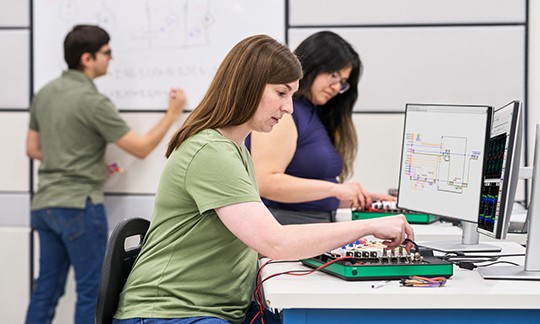
Portable equipment from Digilent made that possible outside the campus lab. UAH keeps two traditional bench setups and organizes the rest into kits: local students check one out, and students farther away—as far as Alaska—buy their own. Wherever the student is, the goal stays the same: let them work through the problem themselves.
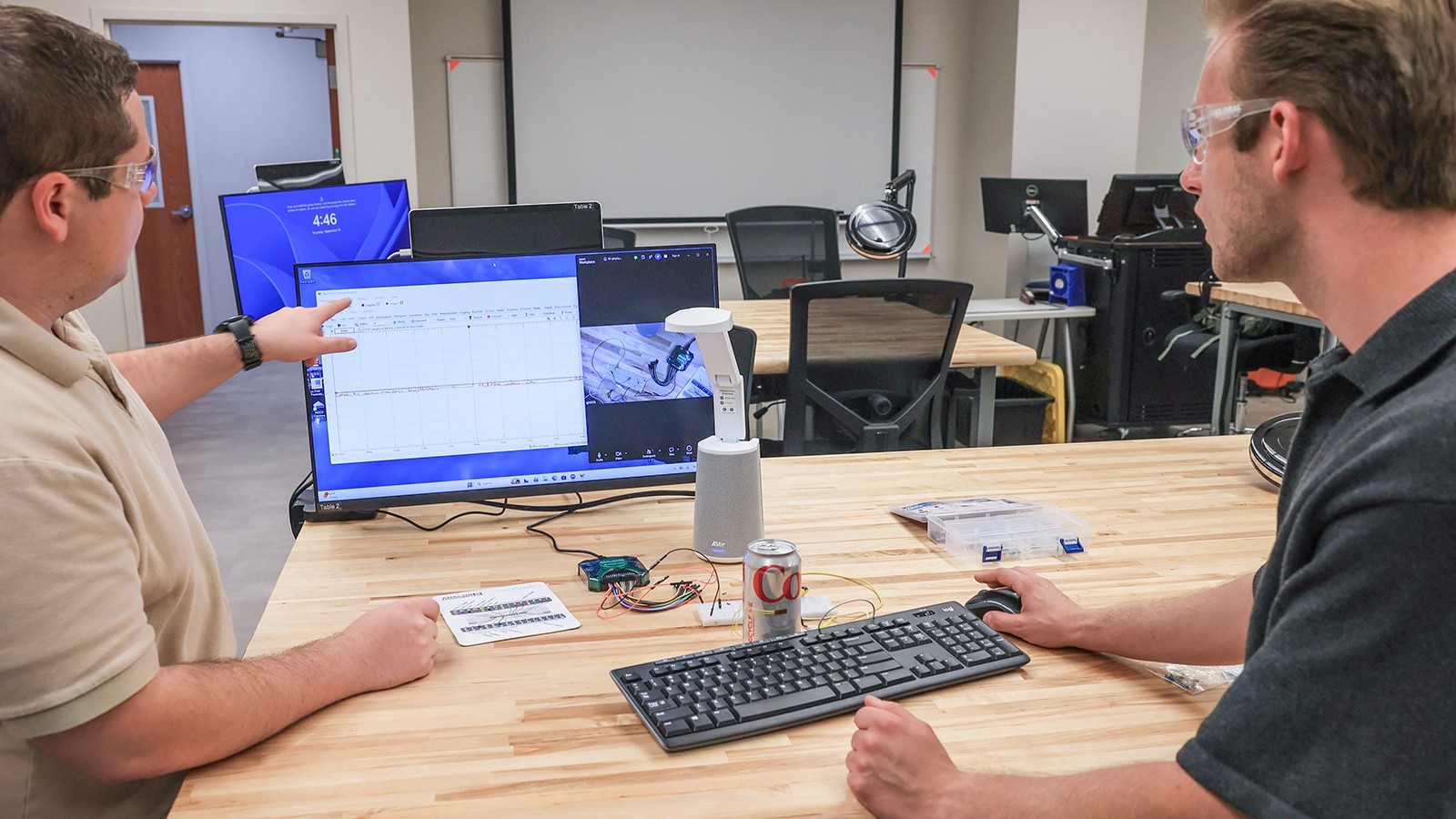
One UAH lab uses strain gages taped to soda cans, wired into a basic Wheatstone bridge. It’s a cheap, portable, slightly odd-looking setup—and the learning inside it is completely real. Students wire the components, take the readings, and decide for themselves whether the number in front of them makes sense. They aren’t just learning how a circuit should behave. They’re learning what to do when it doesn’t.
The Answer Is Only the Beginning
The instinct to question a result matters more now that AI technology has entered the classroom. Assignments that once gave a clear signal of learning no longer do, so UAH has leaned harder into oral and lab-based assessment: a remote student might record themselves solving a circuit problem out loud, then answer follow-up questions about why they made the choices they did.
Henrie isn’t trying to keep AI tools out of the classroom. She sees real value in them and knows students will use them constantly after graduation. Her job, as she sees it, is to teach them how to use it well.
One faculty member is testing this in a classic vector problem involving a boat crossing a river: students use AI tools to build a visual model, then change the vectors and watch the outcome shift. The assignment doesn’t end when the model runs; they still have to explain the concept and show they understand what they built. That distinction matters because AI can move fast without being right. Engineers still need enough grounding to catch it when it’s wrong. For Henrie, the question hasn’t changed: does this make sense? An unexpected answer might point to a bad assumption or a loose connection, and what matters is whether the student is curious enough to dig in rather than take the first result at face value.
Learning at the Interfaces
Henrie believes the most interesting thing in any system happens at its interfaces, the connection points where problems tend to surface. She sees the same pattern between people and AI technology: the opportunity isn’t in what the technology can do alone, but in how human judgment meets it—which is part of why interdisciplinary work matters to her. The real world doesn’t sort itself into separate subjects, and students who understand how technologies and people connect are better at asking the right questions.
UAH’s classrooms bring their own kind of range. Students span ages 17 to 56, and the more experienced ones often mentor the younger ones. Some are enthusiastic about AI; others are wary of it for environmental, ethical, or workplace reasons, and some can’t use public tools on government computers at all. Those differences turn into real conversations about when a technology should be used, not just what it can do.
Creating More Ways Into Engineering
That same commitment to access now reaches past UAH’s own students. A senior capstone team is designing a robotics and 3D-printing lab for an after-school program and orphanages in Bolivia, grown out of a partnership with the nonprofit Yapay, and is thinking hard about which tools will actually work for kids with little prior access to STEM.
It connects to the idea running through everything Henrie describes: the returning student finishing a long-delayed degree, the airman continuing coursework after a transfer, the remote learner wiring a circuit at their kitchen table, and now a child in Bolivia encountering robotics for the first time. Their circumstances differ, but each deserves the chance to move from curiosity to experience.
The future of engineering depends on new technology, but it depends just as much on who gets the chance to learn it. Meet students where they are, and the path into engineering gets wider for everyone behind them.