6 Ways AI Will Impact Test Beyond Coding
Overview
How we do test engineering is changing rapidly. Accelerated upstream development of complex products creates fundamental changes in the tasks we must perform, even if our goals remain constant. In the last 10 years, the way we spend our time has evolved, with more focus devoted toward collaborative development methodologies and more time spent on what were once considered peripheral tasks.
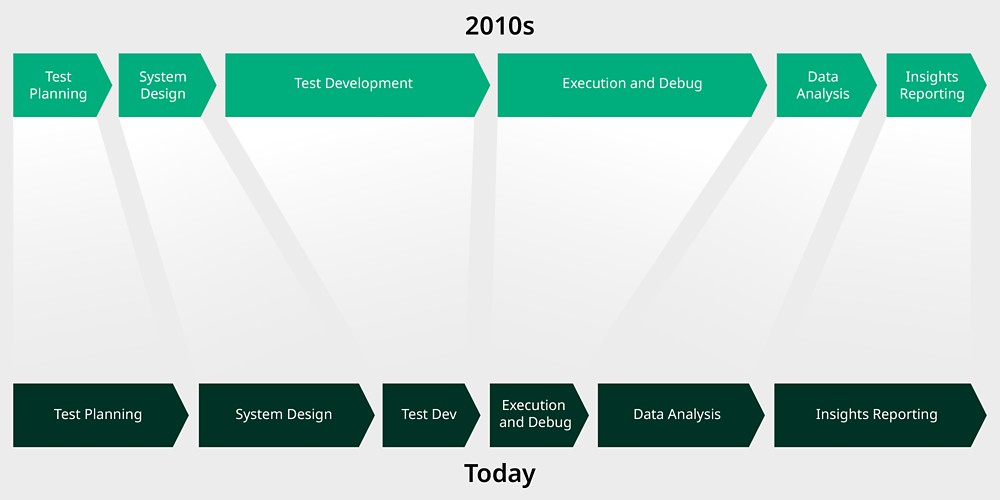
Figure 1. Test Engineering Time Allocation Changes Over the Last 10 Years
Primary Changes in Test over the Last 10 Years
- Need for scalable strategies with standardization options for complex multi-domain products
- Product complexity requires test platform design with software-driven automation, and large-scale data handling, along with high safety and security
- Code bases are transformed from small, static individual projects into continuouslyand optimized libraries built by remote, multi-disciplinary teams.
- Execution, deployment, debugging, and fault analysis become specialized and involved processes with dedicated staff.
- Larger test data sets create high expectation of insights, creating work in analytics and visualization and in data management and format governance.
- Enterprise-grade test operations manage a highly distributed test ecosystem.
This proliferation of tasks means that when presented with a productivity accelerator like AI, the savvy test engineering group thinks holistically about how to apply it to all work they must do and not just the headline grabbing elements of code generation. This white paper is designed to look across the engineer’s workflow and explain why test engineers need to adopt AI in more tasks to be successful.
Contents
- 1. Test Planning and System Design
- 2. Onboarding and Education
- 3. IP Development Through Application Automation
- 4. Debugging and Code Inheritance
- 5. Data and Root Cause Analysis
- 6. System Maintenance and Lab Management
- AI Code Generation Will Only Get You So Far in Test
- Next Steps
1. Test Planning and System Design
Great test engineering starts with a great test strategy rather than just great IP development. However, as the coverage requirements of the products we test grow, the time investment in planning and design of this strategy becomes disproportionately heavy.
AI can help with planning by ingesting product and component space and translating them into a test plan. To do this task, specialist skills are required that provide sufficient knowledge of test methodologies and measurement best practices to deliver a performant plan. As this plan moves into station design, the AI needs skills around optimization strategies such as parallelism to utilize resources effectively as well as switch topologies, debugging accessibility, sources of noise and more.
As every test engineer knows, great test system design is a mixture of art, science, experience, and compromise. As an AI tool specialized in test and measurement applications, NI Nigel™ AI has the skills to make a strong recommendation; its agentic capabilities are rapidly enhancing and deliver the most application-specific support. But engineers should not forget their own practical experience when validating suggestions.
2. Onboarding and Education
Modern test engineers are forced to be adaptable as it becomes more common for workers to switch positions in search of advancement. These changes create a need for almost continual onboarding to new tools and processes. Constant onboarding not only impacts the productivity of the trainee but also takes experienced team members away from their work as they act as trainers.
AI assistants can create the first line of support for engineers using new tools. Our product data shows that more than 20 percent of LabVIEW users regularly use Nigel AI for use cases just like this. To be clear, these tools are not a replacement for more structured training courses covering product best practices. This kind of education is still required, so engineers know what prompts to ask and what a good response looks like. But AI assistants do act as a good refresher and can help engineers navigate complex software environments to find the functions they are looking for without pestering their colleagues.
3. IP Development Through Application Automation
Test IP development almost always involves more than just writing measurement code specific to a test step. There are very complete applications available that support applications like datalogging, test sequence management, and interactive signal debugging, each of which build on top of or can plug into measurement code and allow engineers to work at a faster, more abstracted level. Many of these (like NI FlexLogger, NI TestStand and NI InstrumentStudio™ software) have Nigel AI integrated into them which accelerates development still further.
TestStand, for example, allows Nigel to generate test sequences based upon a contextualized test plan. This tool can be a huge time saver, as it allows the integration of test steps (potentially written in any language such as LabVIEW, Python, or C#) into a single sequence with minimal orchestration overhead for the user. Nigel can then automate the speed optimization features within the TestStand engine to improve performance. In these situations, engineers are still responsible for the sequence delivered to the manufacturing floor and should check the operation, but AI can reduce the number of clicks and creates a starting point to work from to save hours.
4. Debugging and Code Inheritance
One of the most popular use cases for AI is in explaining code to the user. Engineers seldom start from a blank page; they inherit code, reuse code, refactor code, redeploy code, and more. In many cases, inherited code can be a gift, but in others it can take weeks to understand the architecture of some quirky, ill-documented application left behind by a long-gone colleague.
AI can help by summarizing the functionality of a code module or even a whole application and then allowing the user to navigate through it with natural language prompts such as the following examples:
- Where in this application is the database connectivity functionality?
- What libraries and dependencies are required to run this application?
- How do I fix the acquisition timeout error for the vibration measurement?
Using an AI in this way also creates a low-risk profile for AI errors propagating to the code base; by prompting back and forth, it forces the engineer to make changes.
5. Data and Root Cause Analysis
The expectation of data insights is growing within test teams as the one who creates the data is often best placed to manipulate and delve into it. Broadly speaking, test data insights can be categorized into two groups:
- Product insights—Often the eventual responsibility of R&D test groups plays a role in identifying trends or anomalies that pass at first glance, but further details suggest a sustained drift towards potential limits. Common causes could be component change, process change, or supplier/material change.
- Test insights—Identifying outliers due to test station, operator, or environmental variance. Insight here can lead to rapid identification of procedural problems, minimizing retest.
Recording a complete set of environmental metadata for each single piece of measurement data in a structured and standardized way is essential for valuable insights. In order to draw meaningful correlations, you must record information on the product (requirements, variance, operating ranges), test system (assets, location, fixturing, operator), test IP (software stack, decencies, revisions) and measurements results (scalars, waveforms, timestamps—complete synchronized for all instruments in use). This kind of data cannot be “added back in” if not documented at the point of measurement and so a strong metadata recording strategy within measurement systems becomes essential to successful AI driven insights at a later point.
6. System Maintenance and Lab Management
Test engineers did not spend years training through academic and industry to spend long hours searching labs or lines for calibration stickers, missing cables, software inconsistencies, and similar important yet arduous tasks. AI is proficient at searching for things and can save hours of frustrating time in lab maintenance.
For example, using Nigel in NI SystemLink™ software, you can ask questions like:
- “How many of the DMMs in my lab will be out of calibration in the next 3 months?”
- “What is the % utilization of the RF stations across my lab and the lab in Malaysia?”
- “When is the next unscheduled 24-hour period across stations 1–5 so I can do a large software update required by IT?”
By automating these kinds of administrative tasks, teams can maximize the productive time of their core engineering personnel. This automation can help raise team engagement and motivation, as it reduces the time spent on what are perceived as frustrating, repetitive, and low-value tasks.
AI Code Generation Will Only Get You So Far in Test
This white paper has very much glossed over the advantages and failings of using AI to help you write code—and there are many. However, it has also hopefully laid out how the productivity of the engineer can be enhanced by taking a broader more holistic view to the role AI can play in assisting them.
Nigel AI is optimized specifically to aid test engineers throughout their development process—from the first planning meeting to the final report meeting and everything in between. Its unique set of skills along with its close integration into many of the tools you are already using fort test mean that it can act as a catalyst, accelerating your most valuable and creative test tasks while abstracting and automating the administrative ones—all without disrupting your existing processes.