LabVIEW Biomedical Toolkit API Reference

EEG FFT Spectrum VI

  • Updated2023-02-21
  • 10 minute(s) read

EEG FFT Spectrum VI

Owning Palette: Biosignal Measurements VIs

Requires: Biomedical Toolkit

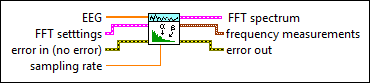
Computes the single-sided power spectral density (PSD) of an electroencephalogram (EEG) signal by using the Welch method and extracts the frequency-domain measurements of the EEG signal.

You must manually select the polymorphic instance to use.

Example

EEG FFT Spectrum (Waveform)

EEG specifies the input EEG signal.
FFT settings specifies the fast Fourier transform (FFT) parameters, including window settings, frequency bins, and frequency band settings.
window settings specifies the information of the sliding window that divides the time series into subsequences.
window specifies the time-domain window that this VI applies to the time series.

0None
1Hanning (default)
2Hamming
3Blackman-Harris
4Exact Blackman
5Blackman
6Flat Top
74 Term B-Harris
87 Term B-Harris
9Low Sidelobe
length specifies the length of the window. A large window generates a PSD with small bias but results in a coarse PSD plot. A small window generates a smooth PSD plot but leads to large bias. The default is 1024.
overlap specifies the overlap, in percentage, of the moving window that this VI applies to the time series. overlap determines how much data this VI reuses for the signal space matrix. A large overlap reduces the variance of the resulting power spectrum but increases computation time. The default is 50, which specifies that the overlap is half of the window length.
dB on? specifies whether this VI returns the PSD in decibels or in a linear scale. If dB on? is TRUE, this VI returns the PSD in decibels. If dB on? is FALSE, this VI returns the PSD in a linear scale. The default is FALSE.
frequency bins specifies the number of frequency bins for which this VI computes the single-sided PSD. The length of the single-sided PSD is (frequency bins/2+1). The default is 1024.
frequency bands specifies the frequency ranges of delta activities, theta activities, alpha activities, and beta activities to calculate the FFT measurements.
delta high specifies the high limit of the frequency band of delta activities, in hertz. The default is 4.
delta low specifies the low limit of the frequency band of delta activities, in hertz. The default is 0.5.
theta high specifies the high limit of the frequency band of theta activities, in hertz. The default is 7.5.
theta low specifies the low limit of the frequency band of theta activities, in hertz. The default is 4.
alpha high specifies the high limit of the frequency band of alpha activities, in hertz. The default is 13.
alpha low specifies the low limit of the frequency band of alpha activities, in hertz. The default is 8.
beta high specifies the high limit of the frequency band of beta activities, in hertz. The default is 26.
beta low specifies the low limit of the frequency band of beta activities, in hertz. The default is 14.
error in describes error conditions that occur before this node runs. This input provides standard error in functionality.
FFT spectrum returns the FFT spectrum of the input EEG signal.
f0 returns the lower boundary, in hertz, of the frequency range.
df returns the frequency increment, in hertz.
S(f) returns the magnitude of the PSD at each frequency. The value of dB on? determines the unit of measurement for S(f).
frequency measurements returns the frequency-domain measurements of the spectrum of the input EEG signal.
delta power returns the absolute value of power in the frequency band of delta activities.
theta power returns the absolute value of power in the frequency band of theta activities.
alpha power returns the absolute value of power in the frequency band of alpha activities.
beta power returns the absolute value of power in the frequency band of beta activities.
delta returns the distribution of power in the frequency band of delta activities.
theta returns the distribution of power in the frequency band of theta activities.
alpha returns the distribution of power in the frequency band of alpha activities.
beta returns the distribution of power in the frequency band of beta activities.
error out contains error information. This output provides standard error out functionality.

EEG FFT Spectrum (Array)

EEG specifies the input EEG signal.
FFT settings specifies the fast Fourier transform (FFT) parameters, including window settings, frequency bins, and frequency band settings.
window settings specifies the information of the sliding window that divides the time series into subsequences.
window specifies the time-domain window that this VI applies to the time series.

0None
1Hanning (default)
2Hamming
3Blackman-Harris
4Exact Blackman
5Blackman
6Flat Top
74 Term B-Harris
87 Term B-Harris
9Low Sidelobe
length specifies the length of the window. A large window generates a PSD with small bias but results in a coarse PSD plot. A small window generates a smooth PSD plot but leads to large bias. The default is 1024.
overlap specifies the overlap, in percentage, of the moving window that this VI applies to the time series. overlap determines how much data this VI reuses for the signal space matrix. A large overlap reduces the variance of the resulting power spectrum but increases computation time. The default is 50, which specifies that the overlap is half of the window length.
dB on? specifies whether this VI returns the PSD in decibels or in a linear scale. If dB on? is TRUE, this VI returns the PSD in decibels. If dB on? is FALSE, this VI returns the PSD in a linear scale. The default is FALSE.
frequency bins specifies the number of frequency bins for which this VI computes the single-sided PSD. The length of the single-sided PSD is (frequency bins/2+1). The default is 1024.
frequency bands specifies the frequency ranges of delta activities, theta activities, alpha activities, and beta activities to calculate the FFT measurements.
delta high specifies the high limit of the frequency band of delta activities, in hertz. The default is 4.
delta low specifies the low limit of the frequency band of delta activities, in hertz. The default is 0.5.
theta high specifies the high limit of the frequency band of theta activities, in hertz. The default is 7.5.
theta low specifies the low limit of the frequency band of theta activities, in hertz. The default is 4.
alpha high specifies the high limit of the frequency band of alpha activities, in hertz. The default is 13.
alpha low specifies the low limit of the frequency band of alpha activities, in hertz. The default is 8.
beta high specifies the high limit of the frequency band of beta activities, in hertz. The default is 26.
beta low specifies the low limit of the frequency band of beta activities, in hertz. The default is 14.
error in describes error conditions that occur before this node runs. This input provides standard error in functionality.
sampling rate specifies the sampling rate of the EEG signal. sampling rate must be greater than zero. The default is 1.
FFT spectrum returns the FFT spectrum of the input EEG signal.
f0 returns the lower boundary, in hertz, of the frequency range.
df returns the frequency increment, in hertz.
S(f) returns the magnitude of the PSD at each frequency. The value of dB on? determines the unit of measurement for S(f).
frequency measurements returns the frequency-domain measurements of the spectrum of the input EEG signal.
delta power returns the absolute value of power in the frequency band of delta activities.
theta power returns the absolute value of power in the frequency band of theta activities.
alpha power returns the absolute value of power in the frequency band of alpha activities.
beta power returns the absolute value of power in the frequency band of beta activities.
delta returns the distribution of power in the frequency band of delta activities.
theta returns the distribution of power in the frequency band of theta activities.
alpha returns the distribution of power in the frequency band of alpha activities.
beta returns the distribution of power in the frequency band of beta activities.
error out contains error information. This output provides standard error out functionality.

Example

Refer to the EEG Spectrum Analysis VI in the labview\examples\Biomedical\Biosignal directory for an example of using the EEG FFT Spectrum VI.