Introduction to Time Series Analysis
- Updated2025-10-28
- 4 minute(s) read
A time series is a sequence of observed values ordered through time. Time series analysis uses a collection of systematic approaches to extract information about the characteristics of a physical system that generates time series.
For example, the air temperature in meteorological science, blood pressure in biomedical science, or vibration in mechanical engineering or civil engineering are examples of a time series. Approaches to time series analysis include estimating statistical parameters, building dynamic models, performing correlations, computing the Power Spectral Density (PSD), and others.
Generally, a time series contains the following information:
- The characteristics of the time series, such as amplitude, spectral content and other statistical characteristics.
- The native characteristics or structural parameters of a system that generates the time series, for example, the natural frequency and damping of a civil structure.
- The characteristics of the input or stimulus to the physical system that generates the time series.
Continuous Time Series and Discrete Time Series
In nature, physical quantities such as temperature, pressure, and light intensity change continuously. Observations of these values form a continuous time series.
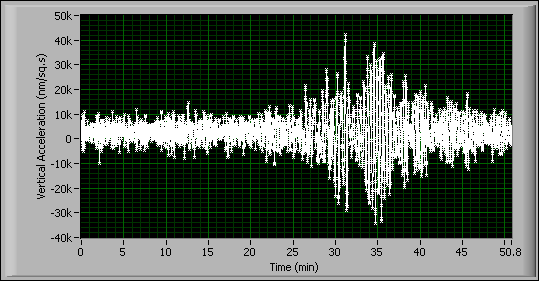
Given a continuous time series, you can digitize the values at a specified time interval to obtain a discrete time series. The following figure shows the seismograph of the Kobe earthquake, recorded at Tasmania University, Hobart, Australia on January 16, 1995. In this figure, the continuous earthquake vibration signal is sampled at a one-second interval to form a discrete time series.
Time-Ordered Series and Spatial-Ordered Series
Time series can be ordered not only through time but also through other physical units. For example, you can obtain a discrete time series ordered versus angular position by sampling the diameter of a spindle as a function of angle.
The following figure shows an example of the diameter error as a function of angle of a spindle during a lathe machining process. The diameter error generates a discrete time series ordered versus angular position.

Univariate Time Series and Multivariate Time Series
You can collect observed values from a single source or simultaneously from two or more sources. Single-source observations generate univariate time series, and multi-source observations form multivariate time series, or vector time series. For example, you can obtain a multivariate time series by recording the values of pressure, flow, and temperature simultaneously in an industrial process.
The following figure shows an example of the vibration signals from a steel-reinforced concrete beam. The signals are acquired simultaneously from seven acceleration sensors located at different positions on the beam.

Stationary Time Series and Nonstationary Time Series
In theory, given a behavioral model for a system, you can predict future values of a time series measured from that system, based on past observations. However, in practice, physical systems are affected by many kinds of disturbances, so the predicted values always reflect the stochastic, or statistical, characteristic of a time series.
Generally speaking, if the statistical characteristic of a time series contains no systematic change, the time series is stationary. Otherwise the time series is nonstationary.
Time Series Analysis Objectives
Time series analysis is useful when you want to extract information from a time series, to discover the characteristics of a physical system that generates the time series, to predict the changes of a time series, or to improve control over the physical system. The objectives of time series analysis are as follows:
Time series exist in many application areas, ranging from economics to engineering. The LabVIEW Time Series Analysis Tools focus more on the applications in engineering. Use the Time Series Analysis VIs to analyze or process a time series.